Showing posts with label Buyer Beware. Show all posts

Monday, July 20, 2026

BOYCOTT TAYLOR FARMS and EARTHBOUND FARMS ORGANIC

BOYCOTT TAYLOR FARMS:  Meet Bruce Taylor, of Taylor Farms.  This man makes huge contributions to Trump, so his lettuce is never inspected.  

So far, this man has given us E. coli, and cyclospora. He does NOT allow his lettuce pickers to take bathroom breaks. Kroger brand lettuce is actually Taylor’s, as is Sysco’s— which supplies a large percentage of restaurants in the US!

2026 cyclosporiasis outbreak:  In 2026, Taylor Farms was linked to a cyclosporiasis outbreak from iceberg lettuce supplied to Taco Bell. 

As of July 2026, the outbreak was the largest in the U.S. since 1997, including 7,000 confirmed cases and 141 hospitalizations.

EARTHBOUND FARMS ORGANIC SALAD MIXES also owned by Taylor. Never buy from this criminal again. The only way we’re going to shut him down. We certainly can’t count on our current “government” to do anything.


Friday, September 26, 2025

How to Protect Yourself from Scammers

Scenario 1:

I was scrolling on social and saw a sale ad for one of my favorite brands. It looked just like other ads I’d bought from before. The discount was really good, so I clicked on it and went to what looked exactly like their website, even with the free shipping headline.

When I went to check out, I thought it was odd I couldn’t find a place for my credit card, just options for digital payment platforms like Zelle®. But I thought no big deal and paid with Zelle®. I got suspicious when I didn’t get a confirmation email right away like I usually do. I waited about three weeks, but the merchandise never showed up. I tried to put in a claim for fraud with my bank, but I was told there’s no way to get my money back.

Help protect yourself:

Always type in a company’s website address yourself to see if special sales or promo codes are listed there. If not, the ad you’re seeing and the website it’s taking you to are likely a scam. Where possible use your credit or debit card which offers protection features that may not be there if you pay by other means.

Scenario 2:

I got a giant yellow “alert” that covered my computer screen, saying my computer had been hacked. My cursor was even moving on its own, so something definitely seemed wrong. Another alert appeared that looked legitimately from the same brand as my computer, telling me to call the tech support line.

The man who answered was very professional and said they’d been seeing this attack happening a lot lately. He had me go to a website that had all sorts of cyber security information on it and click on a link. He said it would let him see my screen to gauge how bad the attack was. He had me sign into some unimportant websites like a movie site and my pet store. He said everything looked fine, but I should sign into my bank account to also check it. He said he couldn’t see my password as it showed up with just those dots in the password field.  I told him there were no unusual transactions on my account, so he said it looked like it was all a false alarm and hung up. 

Little did I know, that when I gave him remote access to my computer, he was able to see everything I typed. The scammers later signed into my bank account and transferred thousands out.

Help protect yourself:

Scammers know “virus alerts” immediately put computer users into a panic. Never click on virus alerts, even if they look like they come from your computer company or an anti-virus protection company. If you think your computer was impacted, talk to a reputable service provider.

Be careful when using checks. Scammers can steal checks from mailboxes and those not properly disposed of after being deposited. Then, they can use chemicals to erase and rewrite the checks to themselves. They can also sell your personal info or use it to create counterfeit checks.

Check-writing tips:

-Use permanent ink so it's harder to erase.

-Don't leave empty space before the payee or dollar amount.

-Draw a line through the extra spaces.

-Sign the same way every time.

-Mail checks from inside the post office.

-Keep documents safe.

-Review statements regularly.

-Monitor your accounts and verify the payee and check amounts.

-Consider alternative payment methods like Chase Online Bill Pay, Zelle® 

Watch out for scammers impersonating banks:

A scammer calls or texts pretending to be from Chase [or from other banks] and says you need to send money to another account using a wire transfer. They may claim it’s to reverse fraud on your account. Don’t fall for it – it’s a scam! 

We will never ask you to send money to yourself.

Tips to help you stay safe:

-Know who you're talking to: You can verify that you're speaking with us by hanging up and calling the number on the back of your Chase card or your account statement.

-Take a moment: Think about what they're asking for, and verify they are who they say they are, especially if it feels urgent or pressured — it could be a scam.

-Be careful when sending money: It's important to verify you're not sending money to a scammer. Once you send money you may not be able to get it back.

-To help protect yourself, always be suspicious of calls, emails, texts or any communication you receive from someone you don't know — particularly if they want money or your personal information. See below for examples of common scams and tips to be more secure.

-Be cautious of unsolicited calls or texts: If a charity reaches out unexpectedly, say you'll call back using the number listed in the CharityWatch, for more information, Opens overlay or the BBB Wise Giving Alliance, for giving options, Opens overlay

Phishing: Watch out for suspicious calls, emails and texts:

"Phishing" is when you get an email that looks reputable but asks you to call a fraudulent number, respond to the email or go to a website and enter personal information. You may be asked to look at an attachment, which then gives bad actors access to your computer if you open it.

Suspicious messages may have typos or grammatical mistakes. Don't click on links or attachments in an email if you're not sure who it's from.

You can report a suspicious email to us by reporting it to phishing@chase.com. You may also want to report suspicious calls, emails, and text messages by visiting, https://ReportFraud.ftc.gov, Opens overlay

ATM withdrawals:

"Hey, don't forget to use the tap feature on the ATM. I can show you how it works." Don't accept help from strangers at the ATM. Pay attention to your surroundings and watch out for people looking at your screen. 

Computer virus:

"We've detected malware on your computer. Give me access remotely so I can fix that for you." Never give anyone remote access to your computer unless you can 100% verify who they are.

Watch out for charity scams:

Scammers come out of the woodwork to prey on people who are looking to help relief efforts when disaster strikes. Charity scams can appear as fraudulent websites, phishing emails, text messages, crowdfunding sites, phone calls, and postal mail. Being informed is key to protecting your donations. Tactics scammers use 

Impersonation: They mimic established charities or create new ones with similar names.

Emotional appeals: They use heart-wrenching stories and pictures.

Technology: They create and share links to websites that look like they’re legitimate charities.

Verify the charity: Check the legitimacy of the charity and access their official website through CharityWatch, Opens overlay or the BBB Wise Giving Alliance, Opens overlay.


More tips to help you stay safe: 

For sale, hot deal:

"Get a great price on these exclusive sneakers. You can pay using cash or a payment app." Be wary of great "deals" on social media sites. Once you send money you may not get it back.

Someone you 'know':

"I'm with the IRS, and you owe back taxes. If not paid immediately, a lawsuit will be filed against you." Be cautious if you’re told to take action right away. Think about what they’re asking for and verify that they are who they say they are.

'Accidental' payment:

"I didn't mean to send you that money! Please send it back to me right away." Never return any unexpected funds without calling Chase first.

Romance:

"I'm having a medical emergency and need money. I promise to pay it back quickly. Can you help?" Don't send money to anyone you've only spoken to online or by phone.

You've won...!:

"Congratulations! You've won the lottery! We will need to collect taxes prior to your payment." Do not send money to claim a prize. Chances are it's a scam.

Home closing:

"These are the wire instructions to close on your house." Be very cautious of last-minute changes to payment instruction and call your agent or loan officer directly to verify wire instructions before you send money.

Investment:

"You've registered to receive notifications on investment opportunities. Are you ready to invest? I have a once-in-a-lifetime opportunity!" Research the person or company you're dealing with, and make sure they're legitimate.

Spoofing: Look out for scammers in disguise:

Scammers can "spoof" phone numbers. The caller ID can say the call or text is from Chase even though it's not. They do this to trick people into providing their personal or financial information or to get you to send money.

Remember: 

Even if your caller ID says a call or text is from Chase [or another bank], it could be a scam. When in doubt hang up and call us!

-Chase Bank


Wednesday, May 21, 2025

Lawsuit claims Chobani yogurt contains toxic chemicals

Chobani yogurt class action overview:

·       Who: Plaintiff Amy Wysocki filed a lawsuit against Chobani LLC.

·       Why: Wysocki claims the company failed to disclose that its yogurt products contain phthalates, a type of toxic chemical.

·       Where: The Chobani class action lawsuit was filed in California federal court.


A new class action lawsuit alleges Chobani failed to disclose that its yogurt products contain plastic chemicals known as phthalates.

Plaintiff Amy Wysocki filed the class action complaint against Chobani on April 16 in California federal court, alleging violations of state and federal consumer laws.

According to the lawsuit, Chobani’s yogurt products, including Chobani’s Nonfat Plain Greek Yogurt and Chobani’s Whole Milk Plain Greek Yogurt, claim to contain “Only Natural Ingredients” while disclaiming the presence of any artificial flavoring, sweeteners and preservatives.

However, Wysocki claims recent third-party testing revealed that the products contain multiple plastic chemicals, including di-2-ethylhexyl phthalate (DEHP), diethyl phthalate (DEP), dibutyl phthalate (DBP) and a phthalate substitute called di-2-ethylhexyl terephthalate (DEHT).

Wysocki claims these findings contradict Chobani’s prominent front-label and lid representations that its products contain “only natural ingredients.”

Phthalates are endocrine-disrupting chemicals “mainly used as plasticizers added to polyvinyl chloride (PVC) plastics for softening effects” and are detrimental to human health, Wysocki says. 

The chemicals have also been reported as probable human carcinogens by the United States Environmental Protection Agency, she says.

Wysocki is looking to represent anyone in the United States who bought the products. She is

suing for violations of California’s Consumers Legal Remedies Act, Unfair Competition Act, False Advertising Law, breach of express warranty and unjust enrichment. Wysocki is seeking certification of the class action, damages, fees, costs and a jury trial.

In 2023, Chobani faced a class action lawsuit over allegations it falsely advertised that its zero sugar yogurt contains “no sugar” despite the product allegedly containing four grams of allulose, a naturally occurring sugar found in figs, raisins, wheat, maple syrup and molasses.

The plaintiff is represented by L. Timothy Fisher, Julia K. Venditti and Joshua B. Glatt of Bursor & Fisher P.A.

The Chobani class action lawsuit is Wysocki v. Chobani LLC, Case No. 3:25-cv-00907-JES-VET, in the U.S. District Court for the Southern District of California.

https://topclassactions.com/lawsuit-settlements/lawsuit-news/chobani-yogurt-class-action-filed-over-toxic-plastic-chemicals/


Friday, August 16, 2024

Shell USA Company Foundation

A foundation associated with Shell, the Shell USA Company Foundation, donated $544,010 to religious right and conservative organizations, many of which deny that climate change is a crisis, tax records reveal. Fourteen of those groups are on the advisory board of Project 2025, a conservative blueprint proposing radical changes to the federal government, including severely limiting the Environment Protection Agency.


Tuesday, February 21, 2023

Nationwide Federal Order Bars Starbucks From Firing Workers for Union Activity


A federal judge issued a nationwide order late Friday barring Starbucks from firing union organizers—a ruling that affirmed a long-established law which workers say the coffee chain has violated hundreds of times since unionizing efforts were first launched in Buffalo, New York in 2021.

U.S. District Judge Mark Goldsmith ruled in Michigan that former shift supervisor Hannah Whitbeck must be reinstated in her position, which she was fired from in April 2022.

Whitbeck and National Labor Relations Board (NLRB) Detroit Regional Director Elizabeth Kerwin argued that the former worker had been fired because of her involvement in union organizing at the store where she worked in Ann Arbor—one of 366 Starbucks stores across the U.S. where employees have organized to create bargaining units. Nearly 300 stores have won union elections so far.

Starbucks Workers United, the employees' union, has accused the company of firing more than 200 employees in illegal retaliation for organizing.

The company claimed Whitbeck was fired for leaving 20 to 30 minutes early a single time without finding someone to fill in for her, but Kerwin argued that would have been a violation of Starbucks' own policy of issuing a warning for such an incident. Kerwin also noted that Starbucks was aware Whitbeck was involved in unionization efforts.

Jennifer Abruzzo, general counsel for the NLRB, said the nationwide order was significant.

"The district court's ruling confirms that Starbucks continues to violate the law in egregious ways, thus requiring a nationwide cease and desist order," Abruzzo toldBloomberg.

The NLRB has issued 75 complaints against Starbucks for unfair labor practices, including intimidating and retaliating against workers who are organizing.

"Firing workers for organizing is already illegal, of course," said Starbucks Workers United, the employees' union, of Goldsmith's order. "But this decision is HUGE for getting speedy justice for those retaliated against."

Goldsmith ordered Starbucks to post physical copies of the order at the Ann Arbor store and to read it at a mandatory meeting. The company was given 21 days to file an affidavit declaring it had complied.

Starbucks reported a 31% annual growth in profits in 2021, the year workers began unionizing, as well as $8.1 billion just in the fourth quarter of that year. Still, the company has aggressively fought union efforts by holding captive-audience meetings with CEO Howard Schultz and threatening the rights of workers who organize. This past week, Starbucks refused to send Schultz to testify before the Senate Health, Education, Labor, and Pensions Committee on the company's conduct.

Goldsmith's ruling showed that the company "can't just fire" its way out of listening to workers, said economic justice group Fight for $15.

"Love to see the NLRB push back against Starbucks' intimidation tactics," said the group. "Unionizing is a right!" 

-Julia Conley, Common Dreams


Friday, February 3, 2023

What to Know About the Risks of Gas Stoves and Appliances


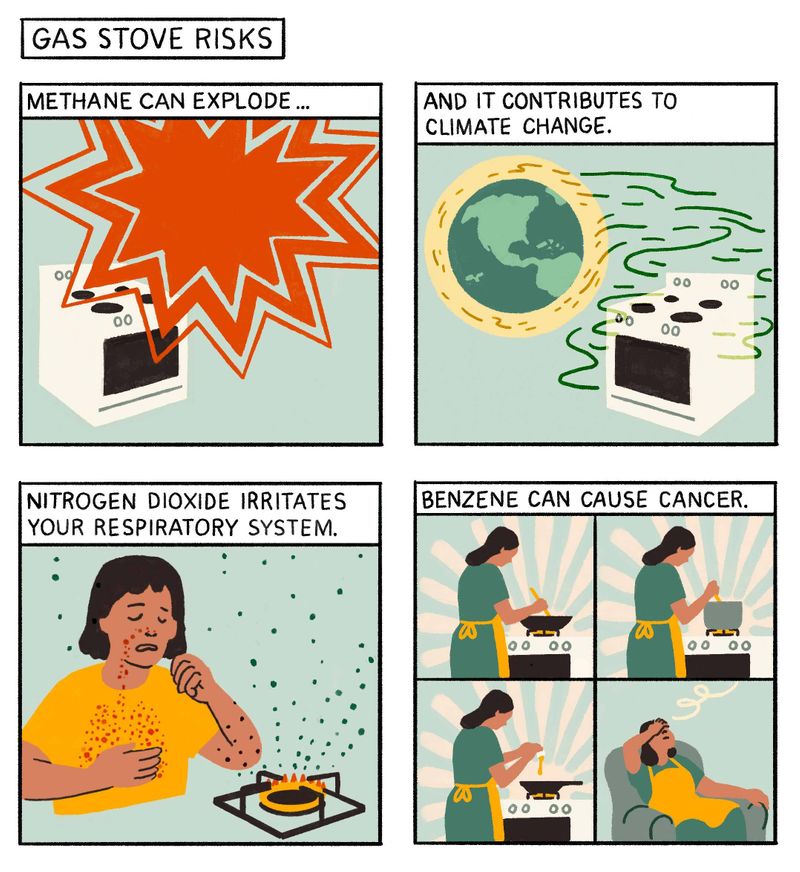
“As a climate reporter, I was well aware of the growing concern about the gas stoves in people’s homes leaking dangerous pollutants, like methane, a potent greenhouse gas and explosive hazard; nitrogen dioxide, which worsens asthma; and benzene, which causes cancer. But I was a renter who had no control over my appliances. So I mostly ignored it — until one day last fall when I smelled the rotten-egg odor of leaking natural gas while baking focaccia.

“I borrowed a $30 gas leak detector from a friend (a fellow climate reporter, of course). When I turned on the oven in my New York City apartment, the lights for a ‘significant’ leak lit up. My kitchen was filling up with methane. According to the user manual, that meant I should ‘VENTILATE THE AREA IMMEDIATELY and move to a safe location’ in case of an explosion.

“I opened the windows and ignored the evacuation advice (don’t follow my example), too intent on taking a video of the leak as proof for my landlord before turning off the oven. Then I vented my frustration by panic-texting friends and eating too much focaccia — after cutting it into pieces and baking it in my toaster oven. Luckily, my landlord replaced my faulty stove within days. I made sure to check the new stove (still gas, alas) for leaks after it was installed.

“‘People still don’t recognize that there are health downsides to cooking with gas in your home,’ said Regina LaRocque, a Harvard Medical School professor who does research on medicine and public health. ‘This is the 21st century, and we have better ways of cooking than over a fire.’

“The issue has caught national attention in recent weeks, as the U.S. Consumer Product Safety Commission considers regulating gas stoves. Public health experts and environmentalists have long warned of the risks of gas ranges. One study found that indoor gas stoves were responsible for roughly 13% of childhood asthma cases in the U.S. The American Public Health Association and American Medical Association have urged consumers to transition away from gas…”


Lisa Song Lisa Song reports on the environment, energy and climate change for ProPublica.

https://www.propublica.org/article/what-to-know-about-gas-stove-risks utm_source=sailthru&utm_medium=email&utm_campaign=majorinvestigations&utm_content=river


Wednesday, December 1, 2021

"What You Shouldn't Pay For" by Chicago Consumers' Checkbook


Air-Duct Cleaning

We call duct cleaning work a solution in search of a problem. Companies that do it claim that their services will improve your home’s air quality, but there’s little evidence this yields any substantial benefits. Even if you have dust allergies, you may want to avoid having your ducts cleaned: The little independent research that exists indicates duct-cleaning work may temporarily worsen problems.

Amazon Prime    

When Amazon launched Prime, its main benefit was free two-day shipping. Now Amazon provides free shipping for much of what it sells if your order is $25 or more. Prime is still worth its $119 annual fee (or $12.99/month) if you regularly watch its original TV shows or movies or other programming available for free to Prime members. And its unlimited cloud storage for photos, its music streaming service, and Subscribe & Save discounts on household and baby products also make membership costs a better deal if you use those services. But many Prime customers aren’t getting their $119-a-year’s worth.

Bottled Water

Each year, U.S. consumers pay more than $100 billion to a bottled water industry that gobbles up about 100 million barrels of crude oil to manufacture and transport plastic bottles. Getting your drinking water from the tap is nearly free and doesn’t waste all that energy. Food & Water Watch, an advocacy group created by Public Citizen, says that tap water in the U.S. is usually safer to drink than bottled water, since it is tested more rigorously. Plus, bottled water is more likely to be contaminated by microplastic particles. If you need to filter your community’s tap water, and your refrigerator doesn’t have a built-in filter, you can buy a standalone model for less than $20.

Cable TV

Thinking about cutting the cord? Droves of consumers continue to join the cable-free club. The growing variety of streaming services like Netflix, Amazon Prime, Hulu, YouTube, Disney+, and Sling TV make it easy to access a plethora of a la carte programming for less moolah than the all-or-nothing plans still sold by cable and satellite TV companies. And because streaming services usually don’t require term commitments, you can subscribe to a few and if you grow tired of what one offers (or its free trial ends), cancel, and move your money to the next one. Some watchers will save as much as $100 a month by saying buh-bye to cable.

Car Leases

Even though ads featuring low monthly payments make vehicle leases look like good deals, in the long run these plans will cost most consumers more than buying. Unless you purchase the wheels at the end of your lease, you have to give back the car and won’t own anything; you’ll then have to lease or buy something else, starting a process of paying for a new ride’s steep depreciation all over again. Plus, you can’t customize a leased car, drive it farther than preset annual mileage limits, or damage it without paying the vehicle’s real owners extra fees. Whether you lease or buy, avoid overpaying. Click here for our advice on how to get the best price on a new car.

Car Repairs at the Dealership

Unless the work you need is covered by a new-car warranty or manufacturer recall, use an independent shop, not a dealership. Many consumers believe dealers have access to proprietary knowledge, sophisticated diagnostic software, and better tools than independent garages. That’s not true. And when we use our surveys of consumers to compare quality of work at dealers and non-dealers, the non-dealers on average score better. We also find that dealerships typically charge a lot more than independents.

Car Repair Warranties

Vehicle extended service contracts are incredibly profitable for auto dealers and other companies that sell them. But because many new cars are very reliable, most owners make few service claims. Even when something goes wrong, many consumers who buy these plans find their claims are often denied due to sneaky fine-print exclusions. We reviewed the lists of excluded repairs buried in several contracts and were left wondering if there was anything on the car left to cover.

Credit Reports, Scores, and Monitoring

Carefully watch your credit and accounts for signs of fraud, but don’t pay a company to do it. Identity-theft monitoring services cost $10 to $30 a month, but you can easily do it yourself for nothing. Federal law entitles you to one free credit report every 12 months from each of the three credit bureaus—Equifax, Experian, and TransUnion. Request yours at AnnualCreditReport.com. You can stagger your requests to get a free report from one of the three major credit bureaus every four months. Because of the pandemic, you can access a free online copy of your credit report from all three credit bureaus once a week until April 20, 2022. And identity theft victims are always entitled to unlimited free credit reports from the credit bureaus. The credit bureaus’ free reports won’t include your credit scores. But you don’t need to pay extra to get yours. Many financial institutions have set up access so their customers can monitor their FICO scores for free; check the websites of your bank, credit union, and credit card companies for how to enroll.

Extended Product Warranties, AppleCare, Etc.

Purchase protection. Service contracts. AppleCare. Whatever retailers call them, these policies are sources of easy revenue for the outfits that hawk them and for the insurance companies that administer them and honor infrequent claims. But we find they are usually bad deals for you. For example, buy an iPhone 11 and for no extra cost you get a one-year limited manufacturer’s warranty covering repairs and 90 days of tech support. Pay an extra $149 for AppleCare and it extends that warranty for another two years; spend yet another $100 and you’ll get coverage for theft or loss. The problem? Even after paying those premiums, you’ll still have to pay extra if you run into trouble. Cracked screen? There’s a $29 deductible to fix it under AppleCare; you’ll pay $99 if your clumsiness or a product defect necessitates a different type of fix. And if you bought Apple’s full-boat policy covering theft and loss, you’ll still have to shell out a $229 deductible to replace a lost phone.

So you’re out $699 for the phone, plus $149-$249 for AppleCare, then up to another $99 if you break it or $229 to replace it. That means if something goes wrong you could be out-of-pocket $248–$478 to cover a $699 purchase. Even if you want an extended warranty, you can usually get it for free. Many credit cards automatically provide free extended warranties when you use them to pay for products that have manufacturer’s warranties. Costco and Sam’s Club also offer free warranty extensions. That so many companies give away extended warranties is an obvious sign that they’re not worth paying for.

HVAC Maintenance Contracts

Some heating and A/C companies swear by these contracts, arguing that regular maintenance helps avoid untimely breakdowns during peak-usage months. But many really push these plans to keep their technicians busy during otherwise slow months—and to maintain a steady flow of revenue. Use our ratings to identify a reputable HVAC contractor and ask it how often your equipment needs service. If you need professional maintenance visits every year—if, for instance, you have a large house or don’t want to perform even the simplest tasks, like changing filters yourself—a maintenance contract might make sense. But most of us won’t benefit much from these plans, and we get a lot of complaints from consumers who buy service contracts and find that technicians discover something to repair on every service visit—at extra cost. Some contractors seem to use service contracts as twice-a-year opportunities to squeeze customers for unnecessary repairs.

Life Insurance—Cash Value and Annuity Policies

Permanent life insurance plans, aka cash value policies, and similarly structured annuity plans are typically bad deals for most consumers. If you want to buy coverage, shop around for a term life policy. The way permanent life plans are structured make them more investment vehicles than reasonably priced insurance policies, and as investments they offer lousy rates of return. You’ll most likely do better by paying a bundle less for term life coverage and investing elsewhere savings earmarked for long-term needs. Click for more advice on buying life insurance. Some quick savings tips: Shop around for the best price, and don’t overinsure—if your kids are 15 years old and you’re 10 years away from retirement, you probably don’t need a 20-year term policy.

Utility Line Warranties

Homeowners across the U.S. often receive ominous, official-looking letters bearing the logos of their utility companies warning they are responsible for repairs to water and sewer lines on their property. The clincher: If there are problems, the homeowner could be on the hook for thousands in repair costs. Although these mailings seem to come from their utilities, they’re really pitches from third-party companies. They’ve struck sketchy partnership agreements with utility companies allowing them use of their names and logos to hawk (in our view, lousy) warranty coverage. The ploys work: So far, more than 7 million homeowners have purchased these plans. But our research found that few homeowners ever have to deal with expensive water or sewer line repairs or replacements. These warranties are bad deals.

For the complete list, click here: 65 Things You (Probably) Shouldn't Pay For - Chicago Consumers' Checkbook


Saturday, October 16, 2021

Why Americans Are Seeing Empty Shelves (by Kevin Ketels)


Walk into any U.S. store these days and you’re likely to see empty shelves. Shortages of virtually every type of product – from toilet paper and sneakers to pickup trucks and chicken – are showing up across the country. Looking for a book, bicycle, baby crib or boat? You may have to wait weeks or months longer than usual to get your hands on it.

I recently visited my local ski shop and they had hardly a boot, ski, goggle or pole to speak of – two full months before ski season begins. The owner said he’s normally close to fully stocked around this time of the year. This may seem a little odd to some Americans given the U.S. has been living with the COVID-19 pandemic for over 19 months. Shouldn’t supply chains stressed by the onset of the pandemic have worked out their kinks by now?

As someone who conducts research and teaches on the topic of global supply chain management, I believe there are four primary – and interrelated – reasons for the continuing crunch. And unfortunately for many, they won’t be resolved by the holidays.

1. Consumer demand soars

When the pandemic first slammed into American shores in March 2020, companies were already preparing for a prolonged recession – and the typical resulting drop in consumer demand. Retailers and automakers, many of which had to close due to lockdowns, canceled orders from suppliers. It made sense. By April, the unemployment rate reached 14.8%, its highest level since the Labor Department began collecting this data in 1948. And consumer spending plunged.

But something strange happened by the end of the summer of 2020. After the initial shock, consumer spending began to rebound and was nearing pre-pandemic levels by September, in no small part thanks to the trillions of dollars in aid Congress was showering on the economy and people.

By March 2021, consumers were again spending record amounts of money on everything from new computers and chairs for home offices to bikes and sporting goods as people sought safer ways to get around and entertain themselves. Demand for consumer goods has only climbed since then. While that’s generally good for businesses and the U.S. economy, the supply chain for most products hasn’t been able to keep up – or even catch up.

2. Missing workers

Even as demand from consumers in the U.S. and elsewhere surges, low vaccination rates at key points in the global supply chain are causing significant production delays. Less than a third of the global population has been fully vaccinated from COVID-19 – and almost 98% of those people live in wealthier countries. Low levels of vaccinated workers in important manufacturing hubs such as Vietnam, Malaysia, India and Mexico have caused production delays or reduced capacity.

Vietnam, for example, plays a key role in the apparel and footwear industry, as the second-largest supplier to the U.S. of shoes and clothes following China. Less than 12% of its population is fully vaccinated, and many factories have been shuttered for long periods due to outbreaks and government lockdowns. Failure to vaccinate more people in developing countries more quickly will likely mean worker shortages will continue to plague supply chains for many months to come.

3. Shipping container shortage

Americans’ insatiable demand for more stuff has another consequence: Empty containers are piling up in the wrong places. Large steel shipping containers are pivotal to global supply chains. In 2020, the U.S. imported more than US$1 trillion worth of goods from Asian countries. And most of those consumer goods make their way to the U.S. on container ships.

To get a sense of the scale, a single container can hold 400 flat-screen TVs or 2,400 boxes of sneakers. But many of those containers making their way to the U.S. don’t have a way to get back to Asia. The reasons involve a lack of workers, complicated customs procedures and a host of other problems. The shortage has driven up the price of containers fourfold over the past year, which in turn is contributing to higher consumer prices.

4. Clogged Ports

All these problems are contributing to another challenge: U.S. ports have become extremely backed up with ships waiting to unload their cargo. A large ship can hold 14,000 to 24,000 containers. That means one ship waiting to make port could hold as much as 5.5 million televisions or 33.6 million sneakers.

Right now, more than 60 container ships are anchored in the ocean off the Ports of Los Angeles and Long Beach, unable to unload their stuff. Ports are also clogged in New York, New Jersey and other locations globally. Normally, there is no wait for these ships to dock and unload their cargo. But the record demand for imports and shortages of truckers, containers and other equipment has caused substantial delays.

No end in sight

Before COVID-19, global supply chains worked pretty efficiently to move products all around the world. Companies utilized a just-in-time philosophy that minimized waste, inventories and expenses. The cost of that, of course, is that even small problems like a hurricane or a factory fire can cause disruptions. And the pandemic has caused a meltdown.

While I don’t expect a resolution to most of these problems until the pandemic ends, a few things could relieve some of the pressure, such as a shift away from consumer spending on goods to services and increased global vaccination rates. But the difficult reality is American consumers should expect bare shelves, delays and other problems well into 2022.

The Conversation, Kevin Ketels Lecturer, Global Supply Chain Management, Wayne State University


Saturday, June 26, 2021

Vehicle Service Contract Plans Are Big Hassles and Bad Deals for Most Drivers (Consumer Checkbook)


Ads from CarShield featuring rapper-turned-actor Ice-T say that buying its vehicle service contracts can help you avoid thousands in auto repair bills. CarShield also hired ESPN’s Chris Berman to urge viewers not to “drive another second without protection.” Several other companies and car dealerships hawk these plans, also known as “extended warranties.” Even some AAA chapters and auto insurance companies such as Allstate and GEICO now sell this type of coverage.

Everywhere we turn, consumers encounter scads of annoying sales pitches for car repair plans. Buy a new or used vehicle from a dealership and the finance manager will try to persuade you to spend thousands on one. Your phone is likely inundated with robocalls selling coverage, often using deceptive and even illegal sales tactics. Your email and U.S. mail boxes get hit with official-looking statements warning that your ride’s manufacturer warranty has expired, or soon will, and you are facing a likely Carmageddon if you don’t buy their plans right now.

These companies promise to pay for repairs you might—but probably won’t—need. We advise against buying these kinds of mini insurance policies—home warrantiesservice contracts for electronicstrip protectionwater-and-sewer line coverageand so on. They are overpriced and highly profitable for the companies that sell and administer them and pay infrequent claims, but are usually awful deals for consumers.

While we advise against purchasing any type of service contract, our review of policies and the complaints filed against CarShield and dozens of other warranty sellers indicates their products are especially lousy buys. These companies commonly use misleading marketing to scare consumers into paying thousands for their products and then, if you actually need repairs, go to great lengths to avoid paying for them.

CarShield and dozens of other warranty sellers have been awarded “F” grades by the Better Business Bureau (BBB). They’ve generated thousands of consumer complaints—so many that the St. Louis-based BBB, which covers southern Illinois and southwest Missouri, where CarShield and many other marketers are headquartered, issued this warning:


“BBB advises consumers to use extreme caution when entering into an extended auto service contract for your vehicle. Consumers report to BBB they feel deceived by misleading advertising, which includes mailers, telephone sales representatives and radio and television commercials. Consumers also state they have difficulty canceling their policies and that requested repairs were not covered by policy administrators.”

Many complaints deal with the insufferable, often illegal robocalls and deceptive marketing mailings commonly used by these companies. Many others highlight what often happens when a customer’s car or truck actually needs to be fixed. All too often, consumers report that after making repair claims, plan administrators found sneaky fine-print reasons to deny their requests for compensation or to limit amounts they’ll pay. Maybe that’s what Chris Berman means when he proclaims that CarShield is “rumblin’ and tumblin’ all over that car repair bill.”

How They Work

Vehicle service contracts are big business, with $35 billion in retail sales in 2018, according to Colonnade Advisors, an investment banking firm. Prices for plans vary depending on the breadth of coverage; vehicle make, age, and mileage; and number of years (the longest terms are seven years or 100,000 miles). We found one plan priced at nearly $6,700 and short-term plans for around $2,500. But most of the plans we checked cost around $3,000 to $4,000.

Generally, the more you pay the broader your coverage. With some companies, paying more upfront lowers or eliminates per-repair deductibles, which are usually around $100. CarShield and most other sellers don’t actually provide the coverage. Instead, claims are handled by third-party “plan administrators”; if you need a repair, you contact the administrator and it decides whether or not to pay for it. Get a repair without first obtaining authorization and you likely won’t get reimbursed for it.

When CarShield responds to customer complaints filed with the BBB, it often points out that its plan administrator, not CarShield, makes claims decisions. The BBB maintains that companies should be responsible for the products they sell, even if their customers interact with a different corporate entity. CarShield is suing the St. Louis BBB, accusing it of being biased against the company and ignoring its efforts to respond to the bureau’s concerns.

In a response filed with the court, the BBB denied the allegations and said that while the company made some changes in its responses to complaints filed with the BBB, it has not addressed the bureau’s ongoing concerns about misleading and deceptive advertising and marketing, nor resolved an ongoing pattern of complaints.

Service contracts marketed by automakers through their dealership franchisees generally require that you use the dealers’ repair shops. That can be a drawback; our surveys indicate that, on average, car owners are more satisfied with repairs done by independent shops than by dealers. Third-party plans like those CarShield sells allow repairs at dealerships or independent shops.


Gotcha! Many Repairs Aren’t Covered

Wade through the fine print for these contracts, as we did for more than a dozen of them, and you’ll find so many excluded repairs that you’ll wonder if there’s anything left on your car that is covered. Common components usually excluded: brake shoes and rotors; clutches; fuel injectors; exhaust systems and catalytic converters; batteries; shocks and struts.

Did the hybrid battery pack fail in your Toyota Prius? Not even that automaker’s Extra Care Platinum Vehicle Service Agreement, Toyota’s most expensive plan, will cover your repair costs. Need to replace a heat shield, battery cable, or the transmission throw-out bearing on your Honda? How about an engine repair due to carbon buildup or overheating? Don’t expect the Honda Care vehicle service contract to cover any of that.

Has your car or truck developed a water leak? Expect to get soaked for that repair. You’ll also pay your own repair bills if a built-in navigation system loses its way or your entertainment system fails to entertain. Most contracts also exclude many non-mechanical parts, such as armrests, seat fabric, door handles, weather stripping, bumpers, and body panels.

Sometimes you can increase coverage by buying a premium plan, but even with such Cadillac coverage we often found long lists of excluded repairs. You’ll also be on the hook for the cost of diagnosing anything that turns out not to be covered. That can be expensive if, for instance, determining the problem requires a shop to tear down your engine or transmission.

Here’s another head-scratcher: Some plans exclude parts such as valve guides, piston rings, and transmission bands if the administrator concludes they failed due to your vehicle’s age or mileage, even with normal operation and use. Ditto if you have age- or mileage-related seepage from your vehicle’s seals and gaskets.

Some plans provide multiple details about what is covered but say little about possible parts and situations that aren’t, and telling the difference practically requires a degree in automotive engineering. “ANY PARTS NOT LISTED ABOVE ARE NOT COVERED,” says a sample contract supplied by American Auto Shield. Some companies list covered and non-covered parts and conditions, a more consumer-friendly approach.

But the contract, listing all these exclusions, often isn’t provided until after the plan is purchased, unless a customer asks to see it in advance or finds a sample on the company website, as we did. That leaves many customers relying on fast-talking salespeople, rosy brochures, and other marketing that fails to highlight all the complicated restrictions.

Oh, Your Repair Is Actually Covered? Well, Get Ready for More Roadblocks

Based on our review of complaints, it’s clear that car warranty plan administrators are passionate about denying claims. CarShield has generated the most complaints to the BBB of any vehicle service contract company we checked; in June 2021, it had racked up 1,850 complaints over the past three years, 1,150 of which were in the last 12 months.

As of June 2021, over the last three years the BBB had received more than 1,000 complaints against the American Auto Shield, a major CarShield plan administrator that also directly markets plans. Many complaints filed against CarShield and other warranty companies describe similar scenarios of denied reimbursement, sometimes even for repairs that should be covered. A big claims-denial strategy: Plan administrators decide a problem existed or was developing before coverage was purchased.

Similarly, plans often deny coverage when administrators conclude drivers failed to take action to avoid or limit damage, such as continuing to drive vehicles after hearing squeaks or rattles, or seeing warning lights. Administrators often also refuse to pay out when customers can’t provide receipts or other proof that they performed all required oil changes on time or otherwise followed the manufacturer’s maintenance recommendations. And—as if that’s not enough—upon sign-up, plans typically impose a waiting period of 30 days or 1,000 miles, during which no repairs are covered. Bernard McMillian of Burgaw, N.C., encountered an extended runaround when he tried using his CarShield coverage for the first time after two years as a customer.

At first, he said, the plan administrator, American Auto Shield, denied his claim for an engine repair on his 2011 Dodge Ram 1500, saying he couldn’t provide receipts for regular oil changes. After he ran around town to obtain them, the company demanded towing receipts to show that McMillian didn’t continue driving the truck after the problem had surfaced. Then he had to pay $900 to have a mechanic tear down the engine and take photographs of the parts that needed repair. Finally, after waiting more than two months, he said, the company agreed to pay for only part of the repair, leaving McMillian on the hook for the cost of replacing a damaged crankshaft.

“I am left having to pay $2,800 because of this useless product and have been without a drivable vehicle for two months while they come up with excuse after excuse for why they won’t honor their policies,” McMillian wrote in his 2020 complaint to the BBB. CarShield told the BBB that American Auto Shield rejected the claim because McMillian continued to drive the vehicle once the problem occurred, causing further damage. It said that if he wanted to pursue the case further, he should arbitrate it with the administrator, as his contract required. “That’s passing the buck,” said McMillian. He said he first purchased the service contract because CarShield commercials made it “sound like a winner to me.” Now he says his wife has to calm him down whenever he sees a CarShield ad on TV.

We found plenty of similar complaints against CarShield and other companies. One consumer who bought a policy offered by Endurance Warranty Services complained to the BBB that he waited for two months to get approval for an engine repair. At first, the company required use of parts that were so inferior that the repair shop refused to use them.

After that issue was resolved, the customer said, the company told the shop that it decided not to cover the repair because the damage apparently occurred during the 1,000-mile waiting period. In responding to the BBB complaint, the company said it had reached a resolution with the customer but didn’t provide details.

As of June 2021, the BBB gave Endurance Warranty Services a “C+” rating and issued an alert for its past advertising practices, including the use of aggressive, confusing, and intimidating mailings, some of which, the BBB said, were sent in envelopes resembling federal tax documents. Over the past three years, the BBB has received more than 775 complaints about the company, 340 of which were filed in the last 12 months.

Although far fewer complaints are filed about plans offered by automakers, some customers expressed frustration with them, too. After a Hyundai owner’s Santa Fe SUV developed leaks in its air conditioner hoses, the Hyundai Protection Plan refused to pay for the $700 repair, saying hoses were excluded from coverage. Checking the contract, the customer confirmed that hoses were indeed not listed among the many air conditioner parts that were eligible for payment if they failed.

However, the customer noted that when the dealer presented the plan, there was a checkmark next to “Climate Control System,” indicating it was covered. “How am I supposed to know what parts are making the A/C system and what [are] not?” the customer asked in a complaint to the BBB. The customer added that the way the contract was formulated and sold “requires a high level of mechanical knowledge about [the] car air conditioning system to even detect potential traps.”


But Wait, There’s More

As if all these aggravations aren’t enough, some plans limit the hourly amount they’ll pay to reimburse your mechanic. For example, unless you pony up an additional premium, the American Auto Shield contract we reviewed limits the payable labor rate to $100 per hour. In most major metro areas, shops’ labor rates are usually higher than that; in some regions, they average more than $140 per hour.

You also could wait weeks just to get a repair authorized. A common complaint we saw involved long delays while companies sent inspectors to assess whether a repair was eligible for reimbursement or requiring second opinions from other repair shops—yet more potential hurdles.

Deceptive and High-Pressure Marketing

As you might expect, the annoying ads, robocalls, and other marketing tactics used by warranty sellers don’t mention all the policy exclusions, claims denials, and other hassles. Instead, they use scare tactics, citing problems that cost thousands of dollars to repair, then providing a solution: Buy one of their plans to avoid disaster.

This misleading, aggressive marketing draws lots of complaints. Consumers—including some who don’t even own cars—are often deluged several times a week or daily with come-ons by companies warning them that their auto warranties have expired or soon will. The scary words “Final Notice” often get bandied about to suggest it’s their last chance to get in on a good thing.

Those who respond often end up being subjected to a tortuous, high-pressure sales pitch. A consumer in Allen, Texas, told the BBB that a representative of Motor Vehicle Services, another BBB F-rated company, “tried to scare and bully me into getting their extended warranty services, which I declined. He made it seem as though I was a criminal for not responding how he wanted me to.”

Some consumers complained that companies tried to mislead them into believing that they were associated with their carmakers or state motor vehicles departments. “The company stated the extended warranty was an absolute requirement of the motor vehicle [department],” said an Elkton, Md., woman who had been subjected to a sales pitch by Safeguard Auto Direct, yet another Missouri BBB F-rated company. “I thought I was talking to the Motor Vehicle Administration the entire phone call.”

A Denton, Texas, man told the BBB that within two months of buying a new Subaru, the Missouri-based Motor Vehicle Services sent three notices warning that his warranty was about to expire. “The whole notice or letter is geared to look like it came from Subaru,” the consumer said. “This could easily coerce someone that didn’t know better.”

Another frequent gripe came from those who purchased policies and then tried to cancel—in some cases because they had changed their minds, in others because they realized they had fallen for a misleading, high-pressure sales pitch. Many said they found it difficult to reach anyone and, when they did, were treated rudely or even had a company representative hang up on them, sometimes repeatedly.

“When I called Motor Vehicle Services to cancel the policy and get a refund, I was yelled at by three different men in their call center, being told I was letting my pride get in the way and that is why I did not want to continue with them,” a Sarasota, Fla., woman wrote the BBB. “They would not let me cancel the policy no matter how many times I asked.”

An Ann Arbor, Mich., customer of US Automotive Protection Services, another BBB F-rated company, had similar issues. “The sales representative continued to berate me for around 10 to 15 minutes, demanding that I consider how many people were out of work due to COVID and that I should not cancel,” he said.

Some said companies continued to bill—or try to bill—their credit or debit cards after they canceled.

Years ago, two principals of US Fidelis, a prominent failed service-contract marketer, were imprisoned after facing federal charges related to, among other things, engaging in some of the very behavior that customers now accuse other companies of employing today, including using deceptive marketing and failing to make required refunds to those who canceled their contracts. It was just one of several companies that sell and back vehicle warranties that have gone out of business over the years, stranding its policyholders.

Don’t Buy These Plans

There’s no point in paying thousands of dollars for coverage for repairs you likely won’t need and backed by companies that often refuse to pay out if you have a problem. Keep in mind that vehicles now come with longer manufacturers’ warranties and better reliability. Most owners will have few problems, which makes it even less likely that a vehicle service contract will be a good bet.

The risk of even expensive car repairs isn’t worth insuring against. When buying one of these plans, you’re betting that the cost of your vehicle’s repairs will exceed the price you pay for the coverage itself. The plan’s seller is betting the opposite—but it gets a lot of leeway in deciding when and how much to pay out for most repairs, which means it’s making a safer bet.

So it’s not surprising then that a survey by Consumer Reports of auto repair service contract customers found more than half never used their coverage; even those who did ended up paying hundreds of dollars more than they saved on repairs.

You’ll do better by planning on paying for repairs yourself. That’s also our advice if you’re thinking about purchasing other kinds of service contracts, whether for your home's HVAC systems or appliancescomputer devices or smartphones, or water and sewer lines. Even if your vehicle needs a repair, you want to be in charge of decisions, not a company focused on holding down its own costs.

One final warning: Be careful when financing the purchase of a new or used car. The Federal Trade Commission warns that some dealers have been caught sneaking the costs of service contracts into loans or leases.