Showing posts with label scams. Show all posts

Wednesday, July 8, 2026

Wall Street Wants to Change the Rules for Your 401(k): It Could Put Your Retirement at Risk


Financial firms want a bigger piece of the $10 trillion in America's 401(k) plans, and the Trump administration is planning a regulatory rollback to encourage less regulated and often riskier investments. 

Most Americans don’t look to their 401(k) plans for excitement or experimentation, instead relying on the promise that steady saving and sober planning will guarantee security in their golden years. But the Trump administration wants to transform the well-worn patterns of retirement investing. 

To do so, it is moving to weaken the main protection workers have over their retirement money. The man in charge of the regulatory rollback is an industry insider whose former clients are among the large companies likely to benefit from his plan.

Since taking office last year, President Donald Trump has loudly called for plans to include less-regulated — and often risky — investments like private equity and cryptocurrency. To achieve that goal, the administration is softening one of the strongest legal protections American workers have: the right to hold an employer accountable when retirement savings are mishandled. The change is designed to give employers cover if their workers’ 401(k)s are deflated by expensive, opaque or unproven investments.

“What they have done is lower the standard for everything,” said Ali Khawar, a former senior official at the Department of Labor, which is charged with enforcing the federal law that governs retirement savings.

Backing this push are Wall Street firms, which want a bigger piece of the $10 trillion in America’s 401(k) plans, and America’s largest employers, who want to avoid class-action lawsuits from their employees. They have a powerful ally in Trump’s pick to lead the effort at the Department of Labor: Daniel Aronowitz, who previously ran a firm that helped large companies protect themselves against worker lawsuits. Now Aronowitz is the one driving changes to the rules those same companies play by.

When the 401(k) replaced pensions as the main way Americans fund their retirement, the investment risk shifted from employers to employees. Instead of the promise of a monthly check, the 401(k) participant gets a tax-sheltered account, usually with an employer matching their contributions, but with no guarantees of how that nest egg will grow. Traces of the old system remain, however. Employers are responsible for overseeing the company’s plan. They choose all the financial service providers and have the final say on what investment options are available to employees. But it’s typically workers who pay for those services out of their 401(k) savings. And it’s workers who suffer from diminished savings if the plan has poor options.

There are plenty of pitfalls for 401(k) savers. The “recordkeepers” that administer 401(k)s may attempt to steer workers to their own in-house funds, whether they are the best options or not. They may sell advisory services of questionable value. And then there are the investment fees, which are the main cost to participants. These are charged as a percentage of each investment. Roughly, a 1% fee for a $10,000 investment would result in a $100 yearly charge. Recordkeepers — companies like Fidelity, Principal, Vanguard and Empower —  and other service providers often receive a cut of these fees. This means that they have the incentive to recommend more-expensive options. 

If employers are lax in their oversight, workers might find themselves overpaying to invest in funds that underperform. Even modest differences in fees or performance can, when compounded over time, make a huge difference in how much someone is able to save for retirement, potentially tens of thousands of dollars at the end of someone’s career. By the Labor Department’s own math, 1% in additional fees can shrink someone’s nest egg at retirement by 28%.

When overseeing retirement accounts, employers have a fiduciary duty to make prudent decisions and put their workers’ interests first. If they allow financial firms to fleece plan participants, they can be held responsible under the Employee Retirement Income Security Act of 1974, a pension-era law that now governs 401(k)s.

Over the last 15 years, employees have increasingly sued large employers over unnecessarily high fees or inferior investment options. Companies like UnitedHealth, Boeing, Verizon and General Electric, without admitting wrongdoing, chose to settle suits for tens of millions. Aronowitz has called the increased litigation a “con game” that misleads judges, argued that such cases should go before a specialized court and labeled the whole enterprise a “scam.” 

Over 90 of these class-action lawsuits against large employers were filed in 2025. To Aronowitz, that’s a big number — his former firm tracked and publicized the rise of these suits as part of its business underwriting liability coverage to employers — but it’s a tiny fraction of the more than 700,000 401(k) plans nationwide. 

ERISA says nothing about which types of investments are prudent; it sets a standard of care, not a list of approved options. It’s up to employers to use their judgment, and employers have generally been wary of allowing cryptocurrency, private equity or hedge funds onto their plans because they are more complex than the usual stocks and bonds, often untested and much more expensive. Nevertheless, Trump issued an executive order last year blaming the limited uptake on “regulatory overreach” and “lawsuits filed by opportunistic trial lawyers” and calling for new rules. 

Aronowitz, as head of the Employee Benefits Security Administration, the Department of Labor office that enforces ERISA, is responsible for following through. His most significant move is a rule to make it far harder for workers to sue. The proposal, which will likely be finalized later this year, outlines a set of factors for employers to consider before approving investments. Just following this process would entitle employers’ decisions to “significant deference” from the courts — a “safe harbor,” or legal shield, meant to guard those decisions from challenge. A company could load a plan with a high-fee private equity fund and be protected from suit as long as it showed it had followed the rule and considered the fees.

To opponents of the change, like Khawar, who was second-in-command of EBSA under President Joe Biden, this is a mere “check-the-box approach,” akin to a teacher awarding a math student an automatic A — even if the answer is wrong — because the student showed their work.

Aronowitz has bristled at this sort of criticism. “Absolutely not,” he said in April at an industry event. “Read the proposed rule. We require a rigorous, objective, thorough and analytical fiduciary process that must be documented.” 

At the same time, Aronowitz is also pulling back on policing plans’ investment choices. In April, EBSA released a bulletin updating its enforcement priorities. In addition to announcing that agency staff must now get Aronowitz’s sign-off before any major enforcement action, it set a new guideline for investigators. “EBSA must avoid cases that unfairly second-guess process-based fiduciary judgments,” the bulletin said, meaning investigators should not challenge an employer’s investment choices if the employer can show it followed the proper steps, regardless of the outcome for workers. 

Tim Hauser, a 34-year-veteran of EBSA who was the highest-ranking career staffer there before retiring last year, said such ideas undermine the heart of ERISA. Under both Republican and Democratic administrations, EBSA was “dedicated to protecting plan participants,” he said, but that has changed under Aronowitz. The ability of courts and regulators to hold employers accountable for using bad judgment when choosing 401(k) investments is “fundamental to this whole system,” Hauser said. “They are proposing to deprioritize it at the same time that they are encouraging plans to invest in more complicated, opaque investments. It’s infuriating.”

The shift at EBSA has also been evident in court. Over the last year, the Labor Department has filed amicus briefs — friend-of-the-court filings that lay out legal arguments for judges — in several class-action lawsuits on the side of the defendant company. In the past, the Labor Department’s briefs had generally sided with the employees. These amicus briefs can be influential. Recently, the agency interceded on Home Depot’s behalf in a case pending before the Supreme Court. The plaintiffs then dropped it.

A Labor Department spokesperson said in a statement to ProPublica that EBSA would prioritize “the highest-risk matters” in order to protect participants. 

In pushing for looser rules and easing enforcement, the Trump administration and Wall Street are aiming for much more than giving workers the option of investing in so-called alternative assets. They predict it will become common, part of a new normal.

In recent years, the typical 401(k) plan has settled into a pattern, one that’s proven popular with investors but less lucrative for the recordkeepers and asset managers that serve plans. Decades ago, actively managed mutual funds, where professionals pick investments and charge for doing so, were dominant. They carried higher fees, often above 1% of the amount in the fund each year. But over time, passive funds, which often track an index of stocks or bonds like the S&P 500, attracted investors with their promise to deliver the same or better results for fees often below 0.1%. 

Investment and administrative fees in 401(k) plans have, on average, steadily decreased. One main reason is the rise of passive funds, but another, experts say, is the threat of litigation. With cheap options broadly available, large companies might have a hard time explaining to a judge why they forced their employees to choose funds that cost 10 times more.

This decline has pinched profit margins in the 401(k) world, said Kai Richter, an attorney with Cohen Milstein who has long specialized in ERISA class-action cases. “So the financial industry is looking for other ways to make money.” 

Nonpublic investments like private equity are, as a rule, actively managed. That means higher fees. If 401(k) plans began to commonly include these investments, the long-term trend of lower fees would halt and perhaps reverse. 

Broad adoption of alternative assets is indeed the administration’s goal. One of the most consequential parts of a 401(k) plan is the default option, since most workers simply leave their money there. Usually, the default is a target date fund, which, based on the investor’s target date of retirement, gradually shifts its composition as that date approaches from mostly publicly traded stocks to mostly bonds, becoming more conservative and less risky as the person gets closer to needing the money. Target date funds haven’t changed much over the past two decades as they’ve soared in popularity. They offer all-in-one simplicity and, since they are often passive, low cost. Adding complex investments like private equity or hedge funds as a standard part of the mix would be a sea change. 

The proposed rule professes to be “neutral” as to what effect the new, lax standard will have on investments, but it confidently predicts that companies will include more alternative assets over time in 401(k)s. That, after all, is the point of the rule, to broaden access to “the potential growth and diversification opportunities associated with alternative asset investments,” as Trump’s executive order put it. After the rule is finalized, plans covering about 5 million participants will add new or modified target date funds that include alternative investments, according to the proposal, and the number will continue to grow every year. 

Over the past year, there’s been a wave of product announcements in the 401(k) industry as financial companies, taking their cues from the administration, have prepared to offer new options to plans. Major firms that manage private investments, such as BlackRock, Apollo and Goldman Sachs, have announced funds for 401(k)s that include private assets. 

Ahead of the proposed rule’s adoption, Empower, the second-largest recordkeeper, has been expanding alternative options through managed accounts where participants opt to have advisers shape their 401(k) portfolios. About 1,000 companies have agreed to offer these investments to their workers, Empower’s CEO said recently. 

But the ultimate effects of the administration’s efforts won’t be limited to alternative assets, and the outcome is far from certain. The proposed rule seems sure to meet legal challenges, and employers, even with Aronowitz’s assurances, might remain reluctant to overhaul their plans. Short of lawsuits, employers may fear blowback from their workers, who surveys show are content with traditional investment options. 

Paul Kiel, business reporter with a focus this year on 401(k) plans.


Sunday, October 12, 2025

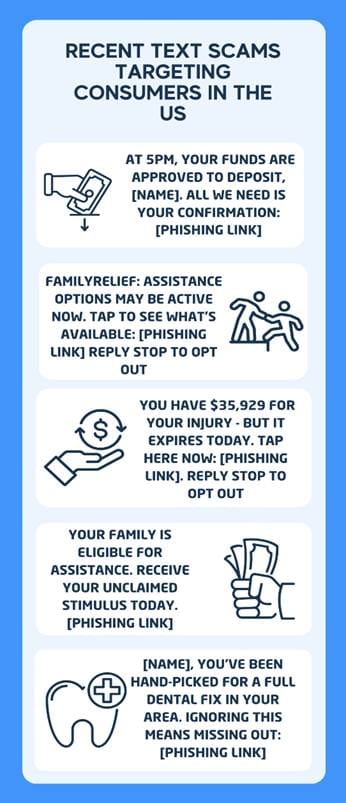
Recent Text Scams


They Wear Our Faces: How Scammers Are Using AI to Swindle American Families

They Wear Our Faces: How Scammers Are Using AI to Swindle American Families


Saturday, October 11, 2025

Experts say not to waste your money — but warn that thieves can swipe your data in other ways


It sounds like a sci-fi movie plot: A scammer uses a card reader to scan your credit card and steal your data from afar. For protection, a range of products — fanny packs, purses, card sleeves, wallets and more, some rather pricey — promise to shield your card from unauthorized access.       

But these scams, theoretically perpetrated through RFID (Radio Frequency Identification) technology, are largely unheard of, experts say, and protective accessories aren’t necessary. “We do not believe this topic addresses a real risk,” says Identity Theft Resource Center (ITRC) Chief Operating Officer James E. Lee. “Chip-enabled payment cards and digital wallets are the most secure forms of payment except for cash.”

How is RFID used in credit cards?

Modern credit and debit cards are embedded with tiny components that use radio waves to communicate with a card reader. This enables you to “tap to pay” or make a contactless purchase, where you briefly tap or hover your card at a checkout terminal —  no swiping or inserting the chip required.

“Simply put, it’s a short-range radio technology that transmits information between two objects,” says Claire Swedberg, the senior editor at RFID Journal, a leading industry publication. 

Digital wallets such as Apple Pay and Google Pay also rely on this technology, Swedberg says, and because of the way your data are encrypted during transactions (more on that below), tap-to-pay and contactless payments are in fact more secure than swiping your card. They’re also more hygienic, she notes, because you minimize contact with surfaces while paying. 

Figuring out if your card uses RFID is simple: Just look for a sideways Wi-Fi symbol (it’s the same symbol found on contactless card readers) printed on the front or back.

Should you be worried about RFID scams?

Technology experts and consumer protection advocates agree that RFID scams don’t pose a credible threat. “It’s just very theoretical fraud,” says Frank McKenna, chief strategist for Point Predictive, a San Diego-based fraud detection company.

Major credit card companies also stand behind the safety of RFID cards. “Fraud from skimming is very unlikely and limited in scope,” Visa’s website notes. Darius Kingsley, head of consumer banking practices at Chase, the largest card issuer in the United States as of 2023, says “I personally don’t worry about this,” when asked about the use of RFID-blocking purses and wallets. “I think more of a risk than anything else is people being careless with their card numbers — writing them down, or having their card sitting out so someone else can see it.” 

Nevertheless, misinformation about RFID persists, Swedberg says. She and other experts point to a few reasons why someone stealing their data remotely, through their wallet or purse, shouldn't be a big concern:

1. Proximity: Someone would have to get close — really close — to surreptitiously scan your card. That’s because credit and debit cards use a form of RFID called near field communication, or NFC. As the name implies, NFC only works at close range: usually a few centimeters, according to Swedberg. That means a scammer can’t read your card by simply standing nearby or walking past you.

2. Encryption: RFID cards generate a secure, one-time code for each transaction that masks your payment information. In addition, personal data such as your name and security number aren’t transmitted with that code — depriving would-be scammers of the information they need to make unauthorized purchases.

3. Consumer protections: Although highly unlikely, if a scammer managed to read and then use your card, such purchases would likely be intercepted or refunded according to your card issuer’s fraud policy.

Bottom line: RFID card scams are a high-effort, low-reward endeavor for criminals, who can more easily access personal and financial data through data breaches and other means.

Are RFID-blocking products legitimate?

While accessories featuring aluminum, carbon fiber and other specialized materials may indeed successfully block your card from communicating via RFID, many companies aren’t transparent about whether their products are truly protective — and so-called “RFID-blocking” accessories are often sold at premium prices without evidence that they live up to marketing claims.

There’s no downside to using RFID-blocking products for peace of mind, but McKenna and other experts note that they’re just not needed. “Don’t waste your money,” he says.

The threat of RFID fraud might be overblown, but McKenna emphasizes that other card-based scams such as skimmers, devices that steal data from your card’s magnetic strip, pose a real risk — as does having your personal data exposed in a data breach (which he says often leave older adults particularly vulnerable, as scammers assume they are high net-worth targets).

But there are key steps you can take to protect your financial data and personal information:

Regularly monitor your bank accounts and credit card statements. Sign up for transaction alerts. If you see any suspicious or unauthorized charges, report them promptly.

Monitor your credit rating. Request a free credit report from each of the three federal credit bureaus every 12 months. See www.annualcreditreport.com for more.

Use strong passwords, and don’t repeat them across accounts. A password manager can help you generate and securely store hard-to-crack passwords.

Avoid exposing your card longer than needed. “As soon as you get it back, put it back where’ it’s covered up,” says Kingsley, noting that rather than worry about someone stealing his card data remotely through RFID, he gets concerned about “having my card out at a restaurant and sitting on a little tray for ten minutes while I wait for the waiter to come and take it.”

Sarah Elizabeth Adler joined aarp.org as a writer in 2018. Her pieces on science, art and culture have appeared in The Atlantic, where she was previously an editorial fellow, California magazine and elsewhere.


Sunday, September 28, 2025

How to Watch for Spotify Scams...


With nearly 700 million monthly active users as of early 2025, Spotify isn't just the world's biggest music streaming platform — it's also a tempting target for scammers. Cybercriminals use fake emails, apps, and even malware to steal Spotify accounts and the personal info linked to them.

If you're a Spotify user — or if your kids or employees are — it's important to understand how these scams work and how to avoid falling for them.

What Does a Spotify Scam Look Like?

The most common type is a phishing email — a fake message that looks like it came from Spotify. These emails usually warn you that there's something wrong with your account. The subject line might say something like:

"Payment failed — Update your billing info"

"Unusual activity on your Spotify account"

"Your account will be closed unless you act now"

They're designed to make you panic and click quickly. The email often includes a link to "fix" the problem — but that link doesn't go to Spotify. Instead, it takes you to a fake website that looks almost identical to the real thing. Once there, you're asked to log in or enter your credit card info. If you do, the scammers now have access to your account — and maybe your bank details, too.

In one real-life case shared online, a user received an email asking them to update their expired card. It looked like a normal Spotify message. They clicked the link, entered their login details, and reached a payment page that seemed a bit off. None of the top menu buttons worked. Curious, they tested the page again — and found it would "log them in" with a completely fake email and password. It was just a trap to collect personal data.

A very similar scam is targeting Netflix users, with fake emails claiming your payment didn't go through. Read more about it: Netflix Suspended Account Scam Active in 23 Countries – How to Stay Safe

How to Tell If a Spotify Email Is Fake:

Some scams are obvious. Others are more polished. But here's what to look for:

-Check the sender's email address.

Legit Spotify messages come from addresses ending in @spotify.com. If you see something else — especially random Gmail or misspelled domains — be suspicious.

-Hover over the links.

Before you click anything, hover your mouse over the link (or hold down on mobile). If it doesn't point to a Spotify domain like spotify.com or accounts.spotify.com, don't click.

-Look for bad grammar or awkward phrasing.

Not all scam emails are sloppy — but many still contain weird formatting, spelling mistakes, or strange phrasing. If something feels off, trust your instincts.

-Watch out for pressure to act fast.

Scammers want you to panic. Take a breath. No real company asks you to fix an issue right now or lose access forever. When in doubt, go to spotify.com directly and log in from there.

Other Spotify-Related Scams to Watch For:

Phishing emails aren't the only danger. 

Here are other ways scammers target Spotify users:

1. Fake Apps and "Enhanced" Spotify Tools

Some websites or social media ads offer unofficial Spotify apps that claim to block ads or unlock Premium features for free. These tools are often malicious — and may steal your account info, install malware, or worse.

Only download Spotify from official sources:

The App Store (iOS)

Google Play (Android)

The official Spotify website

Avoid third-party tools that sound too good to be true. They usually are.

Related: How to Spot Fake Software Deals

2. Malicious Browser Extensions and Software:

Some scammers spread malware by offering browser extensions or software that promise to "improve" your Spotify experience. These programs can steal passwords, track what you type, or download more harmful software without you knowing.

Stick to trusted apps, keep your software updated, and use a reliable security solution that can spot suspicious activity before it becomes a real threat.

3. Account Takeovers from Old Data Leaks:

If you've reused your Spotify password elsewhere, and one of those other accounts gets breached, attackers may use your leaked password to break into Spotify. This is called a credential-stuffing attack — and it works surprisingly often.

Use a unique password for Spotify and make it long and hard to guess. A password manager can help with that.

While Spotify has started rolling out two-factor authentication, not all users have access yet. If it's available in your account settings, turn it on.

Related: Scammers Sell Access to Steam Accounts with All the Latest Games – It's a Trap!

Signs Your Spotify Account Might Be Hacked:

If someone else gets access to your Spotify account, you might notice

New playlists you didn't make

Strange songs or artists in your listening history

Your password no longer works

You're suddenly logged out on all devices

Your email address or payment info was changed

What to Do If You Think Your Account Was Compromised:

If you think someone has broken into your Spotify account, act quickly. Start by logging out of all devices from your account settings to cut off any unwanted access. Then, change your password right away — choose one that's strong and unique, not something you've used before. Next, check which third-party apps have access to your account and remove any you don't recognize or no longer use. Finally, reach out to Spotify Support and let them know your account was compromised so they can help you secure it further.

Scam-Fighting Tools That Really Work:

Scams often rely on panic, pressure, or confusion to get you to act fast — especially when they come through email or pop up while you're trying to enjoy your music. But before you click or respond, you can turn to tools designed to help you pause and verify. Here are some of Bitdefender's most useful scam-fighting features:

Bitdefender Scamio. A free, AI-powered chatbot that helps you figure out if a message or link is a scam. You can send it a suspicious message, link, or even a screenshot through WhatsApp, Facebook Messenger, or Discord — and it will instantly tell you if it's safe. Simple, fast, and surprisingly helpful when you're unsure.

Bitdefender Link Checker. This free tool lets you copy and paste any link to quickly check whether it's risky. It's perfect for double-checking links before opening emails or messages that seem even slightly suspicious.

Real-Time Anti-Fraud and Anti-Phishing Protection. Built into Bitdefender's security products,, these smart filters automatically block known scam and phishing sites — often before you even realize they were a threat.

Spotify scams rely on fast clicks and fear. But with the right tools — and a quick pause to check — you stay in control.

Take action on impersonation:

Roaming the Internet has its challenges. Even the most tech-savvy individuals can face many dangers online. Who would have thought that impersonation is one of them? We’ve all heard of cyber-attacks and data breaches. But what if someone impersonates you?  

Here’s where we’ve really outdone ourselves. Using the information available in your digital footprint, we’re proactively scanning the web for accounts that use your data. Each time a new online profile is created using your information, you can inspect it. If the account is fake, you can take immediate action by following the remediation steps. 

If another individual uses your name, profile picture, similar email address or other information to create profiles on social media in your name, you should always investigate and report the phony account. Someone is definitely not your fan, and impersonation can have serious consequences for you or your loved ones.  It’s not just about defamation or embarrassing the victim -- perpetrators can use your data to trick others into providing additional information about you, your friends, your family or your workplace. 

Keep an eye on profiles with similar data and follow the advice provided to immediately put an end to any sketchy activity. 

 -Bitdefender


Friday, September 26, 2025

How to Protect Yourself from Scammers

Scenario 1:

I was scrolling on social and saw a sale ad for one of my favorite brands. It looked just like other ads I’d bought from before. The discount was really good, so I clicked on it and went to what looked exactly like their website, even with the free shipping headline.

When I went to check out, I thought it was odd I couldn’t find a place for my credit card, just options for digital payment platforms like Zelle®. But I thought no big deal and paid with Zelle®. I got suspicious when I didn’t get a confirmation email right away like I usually do. I waited about three weeks, but the merchandise never showed up. I tried to put in a claim for fraud with my bank, but I was told there’s no way to get my money back.

Help protect yourself:

Always type in a company’s website address yourself to see if special sales or promo codes are listed there. If not, the ad you’re seeing and the website it’s taking you to are likely a scam. Where possible use your credit or debit card which offers protection features that may not be there if you pay by other means.

Scenario 2:

I got a giant yellow “alert” that covered my computer screen, saying my computer had been hacked. My cursor was even moving on its own, so something definitely seemed wrong. Another alert appeared that looked legitimately from the same brand as my computer, telling me to call the tech support line.

The man who answered was very professional and said they’d been seeing this attack happening a lot lately. He had me go to a website that had all sorts of cyber security information on it and click on a link. He said it would let him see my screen to gauge how bad the attack was. He had me sign into some unimportant websites like a movie site and my pet store. He said everything looked fine, but I should sign into my bank account to also check it. He said he couldn’t see my password as it showed up with just those dots in the password field.  I told him there were no unusual transactions on my account, so he said it looked like it was all a false alarm and hung up. 

Little did I know, that when I gave him remote access to my computer, he was able to see everything I typed. The scammers later signed into my bank account and transferred thousands out.

Help protect yourself:

Scammers know “virus alerts” immediately put computer users into a panic. Never click on virus alerts, even if they look like they come from your computer company or an anti-virus protection company. If you think your computer was impacted, talk to a reputable service provider.

Be careful when using checks. Scammers can steal checks from mailboxes and those not properly disposed of after being deposited. Then, they can use chemicals to erase and rewrite the checks to themselves. They can also sell your personal info or use it to create counterfeit checks.

Check-writing tips:

-Use permanent ink so it's harder to erase.

-Don't leave empty space before the payee or dollar amount.

-Draw a line through the extra spaces.

-Sign the same way every time.

-Mail checks from inside the post office.

-Keep documents safe.

-Review statements regularly.

-Monitor your accounts and verify the payee and check amounts.

-Consider alternative payment methods like Chase Online Bill Pay, Zelle® 

Watch out for scammers impersonating banks:

A scammer calls or texts pretending to be from Chase [or from other banks] and says you need to send money to another account using a wire transfer. They may claim it’s to reverse fraud on your account. Don’t fall for it – it’s a scam! 

We will never ask you to send money to yourself.

Tips to help you stay safe:

-Know who you're talking to: You can verify that you're speaking with us by hanging up and calling the number on the back of your Chase card or your account statement.

-Take a moment: Think about what they're asking for, and verify they are who they say they are, especially if it feels urgent or pressured — it could be a scam.

-Be careful when sending money: It's important to verify you're not sending money to a scammer. Once you send money you may not be able to get it back.

-To help protect yourself, always be suspicious of calls, emails, texts or any communication you receive from someone you don't know — particularly if they want money or your personal information. See below for examples of common scams and tips to be more secure.

-Be cautious of unsolicited calls or texts: If a charity reaches out unexpectedly, say you'll call back using the number listed in the CharityWatch, for more information, Opens overlay or the BBB Wise Giving Alliance, for giving options, Opens overlay

Phishing: Watch out for suspicious calls, emails and texts:

"Phishing" is when you get an email that looks reputable but asks you to call a fraudulent number, respond to the email or go to a website and enter personal information. You may be asked to look at an attachment, which then gives bad actors access to your computer if you open it.

Suspicious messages may have typos or grammatical mistakes. Don't click on links or attachments in an email if you're not sure who it's from.

You can report a suspicious email to us by reporting it to phishing@chase.com. You may also want to report suspicious calls, emails, and text messages by visiting, https://ReportFraud.ftc.gov, Opens overlay

ATM withdrawals:

"Hey, don't forget to use the tap feature on the ATM. I can show you how it works." Don't accept help from strangers at the ATM. Pay attention to your surroundings and watch out for people looking at your screen. 

Computer virus:

"We've detected malware on your computer. Give me access remotely so I can fix that for you." Never give anyone remote access to your computer unless you can 100% verify who they are.

Watch out for charity scams:

Scammers come out of the woodwork to prey on people who are looking to help relief efforts when disaster strikes. Charity scams can appear as fraudulent websites, phishing emails, text messages, crowdfunding sites, phone calls, and postal mail. Being informed is key to protecting your donations. Tactics scammers use 

Impersonation: They mimic established charities or create new ones with similar names.

Emotional appeals: They use heart-wrenching stories and pictures.

Technology: They create and share links to websites that look like they’re legitimate charities.

Verify the charity: Check the legitimacy of the charity and access their official website through CharityWatch, Opens overlay or the BBB Wise Giving Alliance, Opens overlay.


More tips to help you stay safe: 

For sale, hot deal:

"Get a great price on these exclusive sneakers. You can pay using cash or a payment app." Be wary of great "deals" on social media sites. Once you send money you may not get it back.

Someone you 'know':

"I'm with the IRS, and you owe back taxes. If not paid immediately, a lawsuit will be filed against you." Be cautious if you’re told to take action right away. Think about what they’re asking for and verify that they are who they say they are.

'Accidental' payment:

"I didn't mean to send you that money! Please send it back to me right away." Never return any unexpected funds without calling Chase first.

Romance:

"I'm having a medical emergency and need money. I promise to pay it back quickly. Can you help?" Don't send money to anyone you've only spoken to online or by phone.

You've won...!:

"Congratulations! You've won the lottery! We will need to collect taxes prior to your payment." Do not send money to claim a prize. Chances are it's a scam.

Home closing:

"These are the wire instructions to close on your house." Be very cautious of last-minute changes to payment instruction and call your agent or loan officer directly to verify wire instructions before you send money.

Investment:

"You've registered to receive notifications on investment opportunities. Are you ready to invest? I have a once-in-a-lifetime opportunity!" Research the person or company you're dealing with, and make sure they're legitimate.

Spoofing: Look out for scammers in disguise:

Scammers can "spoof" phone numbers. The caller ID can say the call or text is from Chase even though it's not. They do this to trick people into providing their personal or financial information or to get you to send money.

Remember: 

Even if your caller ID says a call or text is from Chase [or another bank], it could be a scam. When in doubt hang up and call us!

-Chase Bank


Sunday, August 31, 2025

Scammers


(NEXSTAR) – A multi-phase scam credited with emptying the financial accounts of numerous Americans – many of whom were nearing the age of retirement – is again making headlines after the FBI recently issued a warning.

Unlike many scams, “Phantom Hacker” attacks often come in three distinct phases, each building on the last to thoroughly convince the victim to allow access to their funds. “Victims often suffer the loss of entire banking, savings, retirement, or investment accounts under the guise of ‘protecting’ their assets,” the FBI said in a news release.

Aaron Rose, security architect manager at cybersecurity firm Check Point Software, told Nexstar in an email that the crooks often use victims’ personal interests against them. Fans of vintage cars, antique watches or other items might post publicly on social media, making them vulnerable to bad actors.

“Criminals use personal interests to make their criminal actions appear authentic which decreases the chances of being caught,” Rose said, adding, “AI technology can analyze social media content to detect personal interests and life milestones which allows it to generate messages that seem personalized.”

Since 2024, the scam has reportedly been used to steal over $1 billion in funds, with the majority of victims being at least 60 years old, according to FBI data. “These attacks are not just simple phone calls or phishing emails—they’re complex operations that involve multiple impersonators, spoofed phone numbers, and coordinated follow-ups,” Scott Davis, chairman of the Cybersecurity Association of Pennsylvania, said in a recent interview. “Seniors are being tricked into believing they’re protecting their money, when in reality they’re handing it straight to criminals.”

‘Tech support’ and the first phase

While pretending to work in tech support for a legitimate company, the scammer will use a phone call, text, email or pop-up window to contact the victim. Once the victim calls for tech support help, the scammer instructs them to download a program giving access to the victim’s computer. After pretending to check the device for viruses, the scammer will then suggest the victim open financial accounts to look for unauthorized charges. After choosing an account to target, the scammer tells the victim to wait for a call from the “fraud department” of the bank or institution holding the funds.

A call from the ‘financial institution’

The next phase begins when a scammer, posing as an employee of a well-known financial institution, calls the victim to inform them that their account has been hacked by someone overseas. The only way to keep the money safe, the scammer says, is to move it to a third-party such as the Federal Reserve or a U.S. government agency, according to the FBI. The scammer helps organize the transfer, which is often broken into several transactions and may happen by wire, cash or crypto.

The ‘government’ representative

In an effort to legitimize the prior two phases, a scammer may impersonate an employee of the Federal Reserve or another agency. If the victim starts to get suspicious, the scammer may send a follow-up letter using what appears to be official government letterhead, with the goal of convincing the victim that their funds continue to be “unsafe” and must be moved.

How to protect yourself – and others

Experts say there are a number of steps to take to safeguard yourself against the Phantom Hacker scam, tips that you should also share with family members and other loved ones who might be at risk. “The simplest advice is the most important: never give remote access to your computer if someone calls you unexpectedly,” Rose said. “Do not move your money just because a caller says they are from your bank or the government. Hang up, call the number printed on your bank statement, and verify the situation for yourself.”

If you find yourself unsure of what to do, end the call and talk to someone you trust before taking any action, Rose said. “Scammers rely on secrecy and pressure,” according to Rose. “Breaking that pattern by taking a step back and checking with someone else – a friend, family member, or official from your bank or local law enforcement agency – is often the best defense.”

The FBI encourages anyone who is the victim of a crime to contact the local field office or file a report at tips.fbi.gov. If the crime is internet-based, file a report with the Internet Crime Complaint Center (IC3).

-NewsBreak


Wednesday, July 2, 2025

If a strange package appears at your doorstep


If a strange package appears at your doorstep, there’s no need to panic, but action needs to be taken.

The Postal Service and cybersecurity experts have recommended reporting it: Go to USPIS.gov and file a report with the U.S. Postal Inspection Service. Reporting these scams helps federal investigators trace the origin and stop future incidents.

Auditing your accounts: Check your online shopping, banking and credit card accounts for any unusual charges. It’s also smart to request a free credit report from Equifax, Experian or TransUnion to detect any suspicious activity. 

Updating your passwords: Even if you don’t see fraud, it’s always a good idea to change your passwords, especially for your email, Amazon, bank and any accounts where financial or personal data is stored.


Tuesday, May 6, 2025

Have You Ever Tried to Cancel a Renewal Subscription with Malwarebytes?


Welcome to Malwarebytes Live Chat support. My name is Jonathan [AI?]. How may I assist you today?

Me: I want to cancel my renewal subscription. Navigating the directions are not user friendly!  [I tried to call the (800-799-9570) Help number and, of course, there was no answer. The online instructions I received were ridiculous. They tell you to go to "Sign into Account," then in the "Left Sidebar" (There is no Left Sidebar!) click "Manage Subscription," click the "Billing and Payment Information Tab," then click "Edit Auto-Renewal.  A Pop-Up will appear." (There is no Pop-Up!) "Turn Auto-Renewal Off"; then "Select Reason for Canceling" and click "Send. Once you're done turning off auto-renewal, you'll receive a confirmation email"].

Malwarebytes: I am sorry to hear that. I'd be happy to assist you with it. Before we proceed, is there something our techs or I could do? In case you want to keep your subscription but are experiencing technical issues.

Me: Malwarebytes makes it so difficult to cancel a subscription online.

Malwarebytes: Apologies for the inconvenience.

Me: I do not want or use Malwarebytes anymore.

Malwarebytes: Just to confirm, are you looking to receive a refund for a recent renewal?

Me: Yes! Malwarebytes automatically renewed my subscription. It was charged to my Discover Card.

Malwarebytes: I see. You might have left your auto-renewal active. If you want to proceed with the refund, kindly provide the ref# of the renewal, please.

Me: 25330….

Malwarebytes: Thanks! One moment, please.

Malwarebytes: Upon checking, a chargeback has already been filed regarding this order.

Me: When will a refund be posted on my Discover account?

Malwarebytes: And we are unable to process a refund while the chargeback is ongoing.

Me: Explain

Malwarebytes: You can contact your bank directly for further information. A chargeback may take up to 3 months.

Me: “Chargeback is ongoing?”: What does that mean?

Malwarebytes: We are unable to process a refund for the subscription because a dispute for this transaction was opened with your bank/payment service provider. Once a transaction is disputed, your bank/payment service provider opens an investigation into your claim. The transaction amount is deducted from Malwarebytes and will be processed as a refund, if the dispute is closed in your favor. During this period, if we processed a refund, the order would be refunded twice: once by Malwarebytes, and once by your bank/payment service provider, for the dispute. The following options are available:

• Allow your bank/payment service provider to finish the investigation Note: this might take up to 3 months.

• Close the dispute with your bank/payment service provider. Once the dispute is closed, we are able to issue a refund. If you choose to close the dispute, please send the closure confirmation to our billing partner 2Checkout (Verifone) at chargeback@2checkout.com. For any questions concerning the dispute process, email 2Checkout at same e-mail address.

Me: What does a "bank" have to do with this? It's on a Discover Card!

Malwarebytes: In that case, that is your payment service provider.

Still, the transaction was disputed, which is the reason why we couldn't process a refund. If we processed a refund, the order would be refunded twice: once by Malwarebytes, and once by your bank/payment service provider, for the dispute.

Me: This is absurd!

Malwarebytes: The following options are available:

• Allow your bank/payment service provider to finish the investigation Note: this might take up to 3 months.

• Close the dispute with your bank/payment service provider. Once the dispute is closed, we are able to issue a refund. If you choose to close the dispute, please send the closure confirmation to our billing partner 2Checkout (Verifone) at chargeback@2checkout.com. For any questions concerning the dispute process, email 2Checkout at same e-mail address.


Wednesday, February 19, 2025

Don't let AI phantom hackers drain your bank account


Tech support scams have been around for years, but a new variant called the Phantom Hacker scam is rapidly gaining traction. It has cost victims, primarily older Americans, over $500 million since 2023. This scam is particularly deceptive because it unfolds in three carefully orchestrated phases and uses AI-powered social engineering tactics to avoid detection. Attackers leverage caller ID spoofing and AI-generated voices to make their scheme more persuasive, but there are ways to protect yourself.

How the phantom hacker scam works

As highlighted by the FBI, the scam begins with the tech support impostor phase. You might receive a call, email, text or even a pop-up on your computer warning you that your device has been compromised. The message urges you to call a customer support number for assistance.

Once you do, a scammer posing as tech support claims that hackers have targeted your accounts. To "help," they instruct you to download remote access software, allowing them to take control of your computer. Under the guise of scanning for threats, they trick you into revealing your financial accounts, setting up the next phase of the scam.

Next comes the financial institution impostor phase. Another scammer, pretending to be from your bank or investment firm, calls to warn that a foreign hacker has infiltrated your accounts. They advise moving your money to a "safe" government-protected account, often using wire transfers, cryptocurrency or cash deposits. They might also insist on keeping the transaction confidential, claiming it’s necessary for security reasons.

In the final U.S. government impostor phase, a third scammer impersonates a federal official – often from the Federal Reserve – who pressures you to act quickly. If you start doubting the scheme, they may send you an official-looking email or document to convince you that the transfer is legitimate. By the time victims realize they’ve been tricked, their money is gone, often sent overseas beyond the reach of U.S. authorities.

How AI is making things worse

AI is making scams like the Phantom Hacker scam more deceptive and harder to spot. Scammers are using AI-powered chatbots to automate their schemes. Instead of relying on human operators, they can now deploy AI-driven responses that sound natural and convincing.

AI-generated deepfake voices are also being used to impersonate bank officials and government representatives. With just a short audio sample, scammers can clone a voice to make their calls seem even more authentic. This means a victim might hear what sounds like their bank manager or an official from the Federal Reserve.

Email scams are also becoming more sophisticated. AI tools can craft messages that mimic the tone and style of official communications. Scammers can even generate fake but realistic-looking documents with official letterheads to convince victims that the scam is legitimate.

The best way to defend yourself against the Phantom Hacker scam is to stay informed, be cautious and follow these steps:

1) Ignore unsolicited messages: Scammers often send pop-ups, text messages or emails claiming that your computer is infected or that your bank account is at risk. These messages may look official, but they are designed to create panic and pressure you into taking immediate action. Never click on links or attachments from unknown senders, as they may contain malware or lead to phishing websites that steal your personal information.

2) Have strong antivirus software: The best way to safeguard yourself from malicious links that install malware, potentially accessing your private information, is to have antivirus software installed on all your devices. This protection can also alert you to phishing emails and ransomware scams, keeping your personal information and digital assets safe. Get my picks for the best 2025 antivirus protection winners for your Windows, Mac, Android and iOS devices.

3) Verify phone numbers before calling: If you receive an unexpected message urging you to call tech support, do not use the number provided in the message. Instead, visit the official website of the company in question and find their customer support contact information. Scammers often create fake websites or use caller ID spoofing to make their phone numbers appear legitimate, so always double-check before making a call.

4) Avoid downloading unknown software: No reputable company will ever ask you to install remote access tools unless you have specifically reached out for tech support. Scammers use these programs to take control of your computer, monitor your activity and access sensitive information. If someone unexpectedly asks you to download software to "fix a problem" or "protect your account," it is likely a scam.

5) Never give control of your device to a stranger: If you allow a scammer to remotely access your computer, they can view your personal files, log your keystrokes and manipulate your accounts without your knowledge. Legitimate customer support representatives will never request remote access unless you have initiated the support request through an official company channel. If someone insists on taking control of your device, hang up immediately.

6) Be skeptical of urgent financial warnings: The U.S. government will never contact you unexpectedly and demand that you move your money to a "safe account." They will also never ask you to wire funds, purchase gift cards or send cryptocurrency as a form of payment. Scammers create a false sense of urgency to trick victims into acting before they can think critically about the situation. If someone claims to be from a bank or government agency and pressures you to move money, stop and verify their identity through official channels.

7) Invest in personal data removal services: Scammers often gather information from data broker websites to make their scams more convincing. Your name, phone number, home address and even financial history may be publicly available without your knowledge.

Consider using a data removal service to regularly scan and request the removal of your personal information from these databases. This reduces the chances of scammers targeting you with highly personalized attacks. You can also manually opt out of major data broker sites, but using a service automates the process and keeps your information protected over time. Check out my top picks for data removal services here.

by Kurt Knutsson, CyberGuy Report


Thursday, December 26, 2024

Did you get a package you didn't order? It Could Be a Scam


As you gather all the last-minute holiday packages arriving at your doorstep, be careful about any that you didn't order or ones that don't have a return address and want you to scan a QR code: it could be a scam.

These so-called brushing scams have been around for a few years and there's a few varieties. They can range from a "victimless" crime to one that involves scanning a QR code to find out who the package is from.

That could lead consumers to a site tricking them to enter personal information, similar to a phishing scam. In some cases, malicious QR codes could also install malware to steal information from the consumer's phone.

Police departments around the country have been sharing warning messages on social media about the scams this holiday season.

How does a brushing scam work?

The reports of the brushing scam started a few years ago with packages appearing on people's doorsteps. But when consumers were trying to figure out if it was something they ordered, they contacted Amazon or the retailer only to be told to just keep it, even if it wasn't something they ordered.

Many packages are from Amazon, but from third-party sellers – and an Amazon spokesperson said the company takes action against them.

The sellers are trying to boost their reviews, Jennifer Leach, associate director of the Federal Trade Commission's Bureau of Consumer and Business Education, told USA TODAY.

"Dishonest businesses and scammers are sending all sorts of unordered junk in the mail – and then writing good reviews for their business in your name," Leach.

"That’s bad for honest businesses, which don’t cheat to get reviews, but it could be bad for you, too," she said. "Getting this stuff in the mail could mean a scammer has created an account in your name, taken over your account on the shopping site, or even created new accounts in other names, but tied to your address."

The consumers receiving the product often aren't "harmed" in the scam – and they often get to keep the free product – so some call the brushing scams "victimless" crimes. But the items are usually things consumers don't necessary want and are inexpensive, like ping pong balls or a flashlight.

And future shoppers looking at reviews by the seller who sent the package could be making a bad buying decision based on pumped-up reviews.

What do I do if I receive a package I didn't order?

If you get an unexpected package, there are several steps you can take to protect your identity,” said Melanie McGovern with the Better Business Bureau.

“First, notify the retailer that you received a package, check your account for recent orders, and change your passwords," said McGovern, who also encouraged consumers to report the activity to the BBB's Scam Tracker , www.bbb.org/scamtracker as a warning to others.

Leach with the FTC also said to check online accounts to see if there are any problems.

An Amazon spokesperson provided this statement regarding brushing scams: "Third-party sellers are prohibited from sending unsolicited packages to customers, and we take action when our policies are violated, including by withholding payments, suspending selling privileges, and reporting bad actors to law enforcement."

Amazon suggests if you receive a package or item that you didn't order, check with friends and family or contact Amazon customer service to confirm it's not a gift to you. If you receive a package addressed to someone else, please contact Amazon customer service.

If you can confirm the package addressed to you wasn't ordered by you or anyone you know, report the package online by going to the Report Unwanted Package form on Amazon at https://ac ount-status.amazon.com/report-unwanted-packages .

"Amazon investigates reports of 'brushing' and takes action on bad actors that violate our policies, including suspending or removing selling privileges, withholding payments, and working with law enforcement. Customers don't need to return the item," the Amazon spokesperson said.

What is a QR code scam?

Another type of brushing scam will also have no return address on an unexpected package, but there will be a QR (quick-response) code with instructions to scan on your phone to see who the package is from.

Scams involving QR codes are not new. But with the popularity of QR codes, which when scanned are a shortcut to a website, and are used for tasks ranging from reading a restaurant menu to paying for parking, there are also bad actors.

If you get a package you are not expecting or you didn't order, don't scan the QR code, said the FTC in a blog post in 2023.

"A scammer’s QR code could take you to a spoofed site that looks real but isn’t. And if you log in to the spoofed site, the scammers could steal any information you enter," the FTC blog post said. "Or the QR code could install malware that steals your information before you realize it."

Avoid holiday scams: Don't let fraudsters ruin your holidays. Protect yourself with these tips.

What is a smishing scam?

The U.S. Postal Inspection service also recently issued an alert reminding customers not to interact with text messages indicating your package is lost or with tracking information for a package you did not order.

Smishing is a form of phishing, the fraudulent practice of sending messages disguised as reputable sources to get consumers to reveal personal or financial information, as previously reported by USA TODAY.

Betty Lin-Fisher is a consumer reporter for USA TODAY. Reach her at blinfisher@USATODAY.com or follow her on X, Facebook or Instagram @blinfisher Sign up for our free The Daily Money newsletter, which will include consumer news on Fridays, here. This article originally appeared on USA TODAY: Did you get a package you didn't order? It may be a brushing scam.


Sunday, June 23, 2024

Food Companies Intentionally Make Their Products Addictive, and It’s Leading to Chronic Diseases


Can’t stop eating that bag of chips until you’re licking the salt nestled in the corners of the empty package from your fingers? You’re not alone. And it’s not entirely your fault that the intended final handful of chips was not, indeed, your last for that snacking session. Many common snack foods have been expertly engineered to keep us addicted and almost constantly craving more of whatever falsely satisfying manufactured treat is in front of us.

“Humans have an inherited preference for energy-rich foods—like fats and sugars—and thus natural selection has predisposed us to foods high in sugar and fat,” explains Jennifer Kaplan, who taught the course, Introduction to Food Systems, at the Culinary Institute of America in St. Helena, California.

 “Food scientists know this and create ingredients that are far higher in fat and sugar than occur in nature. The most common such sugar is high-fructose corn syrup and is, therefore, intrinsically addictive.” In fact, foods that weren’t sweet previously, like pasta sauce, are now artificially sweetened to keep consumers craving the product, with sugar levels that can rival those found in packaged desserts.

High-fructose corn syrup (HFCS) is found in everything from ketchup and salad dressing to cereal and bread—foods that aren’t necessarily perceived as sweet—and sometimes even in “healthier” alternatives, like light beer. In 2019, Anheuser-Busch, the St. Louis-based brewer of Bud Light, highlighted the fact that the popular beer didn’t contain HFCS during a controversial Super Bowl commercial

The ad, which tried to push Bud Light as the more desirable light beer because of its lack of corn syrup (as opposed to its competitors), notably annoyed the Midwestern corn farmers, who are subsidized by the U.S. government to essentially keep pumping our processed foods with corn products.

These “multibillion-dollar government programs,” however, don’t reach the small farmers. “The largest 10 percent of farms receive nearly 80 percent of subsidies, primarily for commodity crops such as corn and soy—and entities downstream or upstream of the actual farmers earn most of the profits,” according to a 2023 opinion piece in the Kansas City Star.

High-Fructose Corn Syrup and Salts as Addictive as Drugs

So what’s so bad about HFCS, the ubiquitous ingredient so essential to the inner aisles of the American supermarket? A tablespoon of the super sweet stuff packs in roughly 53 calories, 14.4 grams of carbohydrates, and 5 grams of sugar, while an entire ear of corn has about 123 calories. It’s much easier to ingest extra, empty calories when they’re processed down to a sugary additive, which enhances the flavor of processed foods.

Lower-income households consume higher levels of ultra-processed food, given that it has a longer shelf life, is more accessible, and is strongly marketed. This leads to these households having more health issues like obesity and cardiometabolic disease.

As an ingredient, HFCS was shown in a 2013 study to be as addictive as drugs, like cocaine or heroin, with salt proven to have similarly addictive, opioid-like qualities. Australian neuroscientist Craig Smith has studied the effect of salt cravings in humans for years, concluding that eating excessive amounts of sodium makes people crave salt more, in his 2016 study published in the Proceedings of the National Academy of Sciences. The study suggests that opioid-blocking drugs may inhibit our salt cravings.

“These findings open the way for us to study this salt-seeking circuit in humans using magnetic resonance imaging and other techniques, to then develop targeted drugs to inhibit salt craving and promote more healthy dietary choices,” said Smith, according to a November 2016 article in Cosmos magazine. “If processed food producers are slow to respond to the need to reduce salt in their products, this could be another way to lower deaths associated with high salt intake.”

Even if a particular food isn’t overly salty, it may be sneaked into packaged food more rampantly than expected. “In most cases, salt is used as a preservative to give food extended shelf life and keep food safe,” explains Nia Rennix, a clinical nutritionist who specializes in weight loss and blood sugar regulation. Salt can also be used to enhance a food’s color (such as making the crust of bread a more appealing golden brown), as well as a flavor enhancer in foods you may not associate with saltiness, like ketchup or bread.

You may not be tasting the salt in your mall pretzel or packaged condiments, but salt as an ingredient is keeping you hooked. “Salt is extremely addictive, just as much as sugar. The more you consume salt, the more you crave it, and manufacturers realize this,” says Rennix. “They continue to add salt to foods because they want you to continue to purchase [their products]. 

It doesn’t matter if the salt is white, pink, sea salt, or crystallized—it all has the same effect on one’s body.” Packaging may lead you to think that certain salts are healthier, but truly, they are all equally bad in excess.

The Adverse Health Effects of Too Much Salt and Sugar in Our Foods

Beyond overeating in general, eating too much salt is proven to have negative effects on human health. “Eating too much salt is not good for your health, because the extra water that you hold on to raises your blood pressure. The more salt you eat, the higher your blood pressure,” Rennix explains. “All of this can put a strain on your heart, kidneys, brain, and arteries, which could lead to a stroke, heart attack, or kidney disease.”

And yet, Americans remain casually addicted to the stuff—leading to the looming public health crises of obesity and related illnesses. Based on data from 2017 to March 2020, the Centers for Disease Control and Prevention stated that nearly 42 percent of adult Americans are affected by obesity, a condition closely associated with heart disease, stroke, type 2 diabetes, certain types of cancer, and premature death. Even armed with this knowledge, many Americans are regularly lured in by food that is designed to be hard to resist.

Excessive sugar and salt intake are also causing health issues among children, leading to a rising risk of obesity and effects on blood pressure in childhood. “One in six youth in the U.S. have obesity,” states a January 2024 Forbes article, providing data from the National Survey of Children’s Health. “In the past three decades, childhood obesity in the U.S. more than tripled in adolescents and more than doubled in children,” adds the article.

The United States Department of Agriculture in April 2024 decided to regulate school lunches for children and announced rules that will “limit added sugars” in these meals for the first time between the fall of 2025 and 2027, according to a USA Today article.

“Making items highly palatable is just the beginning,” explains chef and registered dietitian Jessica Swift, who holds an MSc in nutritional sciences. “Pumping food full of sugar to the person with the sweet tooth is what junk food companies strive for. Having that sugar could release dopamine, the feel-good hormone in the brain, which associates that food with pleasure—causing the body to crave more.”

That feel-good sensation will keep you hooked on certain foods, which will bring instant comfort when consumed. “Wanting to repeat that pleasure is natural, and this can lead to overconsumption of said food,” says Swift.

Self-soothing with food is a common, easy, and often cheap tactic for a quick fix, but seeking that comfort can even be less obvious, especially when you’re not necessarily feeling down. For example, smelling a dish outside a restaurant or at a supermarket can evoke pleasant memories that awaken cravings.

“Absolutely, smelling a warm apple pie could remind you of grandma’s Sunday dinners. Gingerbread could remind you of holidays with the family. [Scent can play a part in]… the emotional attachment to food,” says Swift. Associating food with pleasure keeps humans addicted even further to the foods engineered with excessive sugar, salt, and fat to keep you craving more. Sniffing Cinnabon at the mall is a scent that has been proven to entice customers toward consuming previously unwanted calories and sugars.

Moving Away From Highly Addictive Foods

While food addiction is often used colloquially, the Yale Food Addiction Scale has been developed as a measure to determine people’s level of substance dependence. Still, even if not clinically diagnosed, humans can be unhealthily hooked on junk food. So how do we stop it?

“Choose moderation for foods that you think could be highly addictive for you,” Swift recommends. “Make sure you are consuming a well-balanced diet and drinking plenty of fluids.” When grocery shopping for items to stock your pantry with, read nutrition labels and avoid foods with high sodium and sugar content. “Do not keep these foods within arm’s reach,” Swift says. “Typically, when you have to put in an effort to get an item, you are less likely to consume it.” At least in this case, laziness can help your health.

Beyond an individual level, the government needs to implement policies that promote healthy eating habits among people. Americans are getting the majority of their calories from highly processed foods—between 60 percent to 90 percent, leading to a “health crisis,” according to research from 2009-2010.

 “Agricultural subsidies from the U.S. Farm Bill, which primarily support the production of corn, soybeans, wheat, rice, sorghum, dairy, and livestock feed, may be playing a role in unhealthy food consumption patterns,” states a 2020 study published in the journal Nutrients.

Pourya Valizadeh, a research assistant professor in the department of agricultural economics at Texas A&M University, and Shu Wen Ng, a health economist at the University of North Carolina at Chapel Hill, point out the need for the government to move away from incentivizing these food products. 

In an article published in the American Journal of Preventive Medicine in April 2024, they wrote, “Levying national taxes on unhealthy ultra-processed foods/beverages and offering targeted subsidies for minimally processed foods/beverages could promote healthier food choices among low-income households.”


This article was produced by Earth | Food | Life, a project of the Independent Media Institute.

Melissa Kravitz is a writer based in New York. She is a writing fellow at Earth | Food | Life, a project of the Independent Media Institute, and a contributor to the Observatory.  Counterpunch