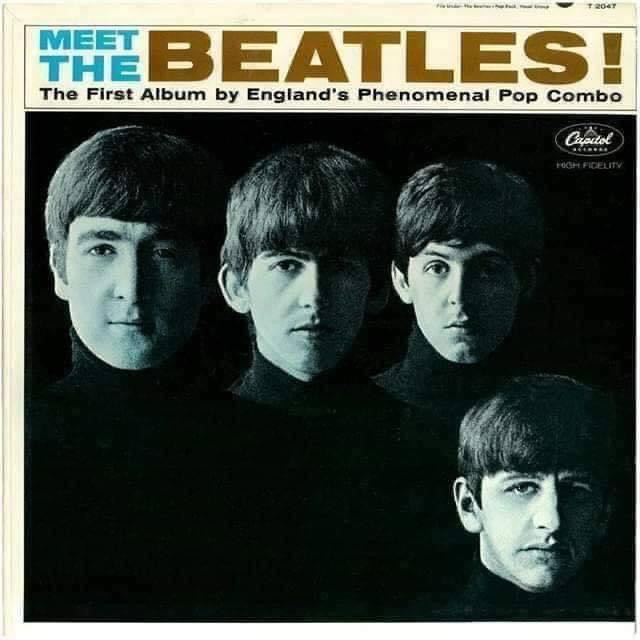
Songs Performed
First
Set:
"All
My Loving"
"Till
There Was You" (a cover)
"She
Loves You"
Second Set:
"I
Saw Her Standing There"
"I
Want to Hold Your Hand"

Songs Performed
First
Set:
"All
My Loving"
"Till
There Was You" (a cover)
"She
Loves You"
Second Set:
"I
Saw Her Standing There"
"I
Want to Hold Your Hand"

Sir Paul McCartney is a key
figure in contemporary culture as a singer, composer, poet, writer, artist,
humanitarian, entrepreneur, and holder of more than 3 thousand copyrights. He
is in the "Guinness Book of World Records" for most records sold,
most #1s (shared), most covered song, "Yesterday," largest paid
audience for a solo concert (350,000+ people, in 1989, in Brazil). He is
considered one of the most successful entertainers of all time.
He was born James Paul McCartney on June 18, 1942, in Liverpool General
Hospital, where his mother, Mary Patricia (Mohin), was a medical nurse and
midwife. His father, James "Jim" McCartney, was a cotton salesman and
a pianist leading the Jim Mac's Jazz Band in Liverpool. He has Irish and
English ancestry. Young McCartney was raised non-denominational. He studied
music and art, and had a happy childhood with one younger brother, Michael. At
age 11, he was one of only four students who passed the 11+ exam, known as
"the scholarship," in Liverpool, and gained a place at Liverpool
Institute for Boys. There he studied from 1953 to 1960, earning A level in
English and Art.
At the age of 14, Paul McCartney was traumatized by his mother's sudden death
from breast cancer. Shortly afterward, he wrote his first song. In July 1957 he
met John
Lennon during their performances at a local church fête (festival).
McCartney impressed Lennon with his mastery of guitar and singing in a variety
of styles. He soon joined Lennon's band, The Quarrymen, and eventually became
founding member of The Beatles,
with the addition of George Harrison and Pete Best. After
a few gigs in Hamburg, Germany, the band returned to Liverpool and played
regular gigs at the Cavern during 1961.
In November 1961, they invited Brian Epstein to
be their manager, making a written agreement in January 1962. At that time
McCartney and Harrison were under 21, so the paper wasn't technically legal,
albeit it did not matter to them. What mattered was their genuine trust in
Epstein. He improved their image, secured them a record deal with EMI, and
replaced drummer Best with Ringo Starr.
With a little help from Brian Epstein and George Martin, The Beatles consolidated
their talents and mutual stimulation into beautiful teamwork, launching the
most successful career in the history of entertainment.
The Beatles contributed
to music, film, literature, art, and fashion, made a continuous impact on
entertainment, popular culture and the lifestyle of several generations. Music
became their ticket to ride around the world. Beatlemania never really ended
since its initiation; it became a movable feast in many hearts and minds, a
sweet memory of youth, when all you need is love and a little help from a
friend to be happy. Their songs and images carrying powerful ideas of love,
peace, help, and imagination evoked creativity and liberation that outperformed
the rusty Soviet propaganda and contributed to breaking walls in the minds of
millions, thus making impact on human history.
All four members of The Beatles were
charismatic and individually talented artists, they sparked each other from the
beginning. Paul McCartney had the privilege of a better musical education,
having studied classical piano and guitar in his childhood. He progressed as a
lead vocalist and multi-instrumentalist, as well as a singer-songwriter. In
addition to singing and songwriting, Paul McCartney played bass guitar,
acoustic and electric guitars, piano and keyboards, as well as over 40 other
musical instruments.
McCartney wrote more popular hits for the Beatles than other members of the
band. His songs Yesterday, Let It Be, Hey Jude, Blackbird, All My Loving,
Eleanor Rigby, Birthday, I Saw Her Standing There, I Will, Get Back, Carry That
Weight, P.S. I Love You, Things We Said Today, "Hello, Goodbye," Two
of Us, Why Don't We Do It in the Road?, Helter Skelter, Honey Pie, When I'm 64,
Lady Madonna, She's a Woman, Maxwell's Silver Hammer, "Ob-La-Di,
Ob-La-Da," Mother Nature's Son, Long And Winding Road, Rocky Raccoon, Sgt.
Pepper's Lonely Hearts Club Band, The Fool on the Hill, You Never Give Me Your
Money, Your Mother Should Know, The End, Yellow Submarine, and many others are
among the Beatles' best hits. Yesterday is considered the most covered song in
history with over three thousand versions of it recorded by various artists
across the universe.
Since he was a teenager, McCartney honored the agreement that was offered by
John Lennon in 1957, about the 50/50 authorship of every song written by either
one of them. However, both were teenagers, and technically, being under 21,
their oral agreement had no legal power. Still, almost 200 songs by The Beatles are
formally credited to both names, regardless of the fact that most of the songs
were written individually. The songwriting partnership of John Lennon and Paul
McCartney was really working until the mid-60s, when they collaborated in many
of their early songs. Their jamming on a piano together led to creation of
their first best-selling hit 'I Want to Hold Your Hand' in 1963.
In total, The
Beatles created over 240 songs, they recorded many singles and albums,
made several films and TV shows. Thousands of memorable pictures popularized
their image. In their evolution from beginners to the leaders of entertainment,
they learned from many world cultures, absorbed from various styles, and
created their own. McCartney's own range of interests spanned from classical
music and English folk ballads to Indian raga and other Oriental cultures, and
later expanded into psychedelic experiments and classical-sounding
compositions. His creative search has been covering a range of styles from jazz
and rock to symphonies and choral music, and to cosmopolitan cross-cultural and
cross-genre compositions.
Epstein's 1967 death hurt all four members of The Beatles, as
they lost their creative manager. Evolution of each member's creativity and
musicianship also led to individual career ambitions, however, their legacy
as The
Beatles remained the main driving force in their individual careers
ever since. McCartney and The Beatles made
impact on human history, because their influence has been liberating for
generations of nowhere men living in misery beyond the Iron Curtain.
Something in their songs and images appealed to everybody who wanted to become
free as a bird. Their songs carrying powerful ideas of real love, peace, help,
imagination and freedom evoked creativity and contributed to breaking chains
and walls in the minds of millions. The Beatles expressed themselves in
beautiful and liberating words of love, happiness, freedom, and revolution, and
carried those messages to people across the universe. Their songs and images
helped many freedom-loving people to come together for revolutions in Prague
and Warsaw, Beijing and Bucharest, Berlin and Moscow. The Beatles has been an
inspiration for those who take the long and winding road to freedom.
McCartney was 28 when he started his solo career, and formed his new band,
Wings. His first solo album, "McCartney," was a #1 hit and spawned
the evergreen ballad "Maybe I'm Amazed", yet critical reaction was
mixed. He continued to release music with Wings, that eventually became one of
the most commercially successful groups of the 70s. "Band on the Run"
won two Grammy Awards and remained the Wings' most lauded work. The 1977
release "Mull of Kintyre" stayed at #1 in the UK for nine weeks and
was highest selling single in the UK for seven years. In 1978 McCartney's theme
"Rockestra" won him another Grammy Award. In 1979, together
with Elvis
Costello, he organized Concerts for the People of Kampuchea. In 1979,
McCartney released his solo album "Wonderful Christmastime" which
remained popular ever since.
In 1980 McCartney was arrested in Tokyo, Japan, for marijuana possession, and
after a ten-day stint in jail, he was released to a media firestorm. He
retreated into seclusion after the arrest and was comforted by his
wife Linda. Yet he had another traumatic experience when his ex-bandmate, John Lennon, was
shot dead by a crazed fan near his home in New York City on December 8, 1980.
McCartney did not play any live concerts for some time because he was nervous
that he would be "the next" to be murdered.
After almost a year of absence from the music scene, McCartney returned in 1982
with the album "Tug of War," which was well received by public and
enjoyed great critical acclaim. He continued a successful career as a solo
artist, collaborated with wife Linda McCartney,
and writers such as Elvis Costello.
During the 80s, McCartney released such hits as 'No More Lonely Nights' and his
first compilation, "All the Best." In 1989, he started his first
concert tour since the John Lennon's murder.
In 1994, the three surviving members of The Beatles,
McCartney, Harrison, and Starr, reunited and produced Lennon's previously
unknown song "Free as a Bird." It was preserved by Yoko Ono on
a tape recording made by Lennon in 1977. The song was re-arranged and re-mixed
by George Martin at the Abbey Road Studios with the voices of three surviving
members. The Beatles Anthology TV documentary series was watched by 420 million
people in 1995.
During the 1990s McCartney concentrated on composing classical works for the
Royal Liverpool Philharmonic Society, such as "The Liverpool
Oratorio" involving a choir and symphony, and "A Leaf"
solo-piano project, both released in 1995. That same year he was working on a
new pop album, "Flaming Pie," when his wife Linda was diagnosed with
breast cancer, and caring for his wife during her illness meant only sporadic
public appearances during that time. The album was released in 1997 to both
critical and commercial success, debuting at #2 on both the UK and US pop
charts. That same year he was knighted by Queen Elizabeth II as
Sir Paul McCartney for his services to music.
In April 1998, Linda McCartney,
his beloved wife of almost 30 years, mother of their four children, and his
steady partner in music, died of breast cancer. McCartney suffered from a
severe depression and undergone medical treatment. He spent much of the next
year away from the public eye, emerging only to campaign on behalf of his late
wife for animal rights and vegetarian causes.
He eventually returned to the studio, releasing an album of rock n' roll covers
in 1999. "Run Devil Run" made both Entertainment Weekly and USA
Today's year-end top ten lists. McCartney also slowly returned to the public
spotlight with the release of another classical album, "Working
Classical" in November 1999, in recording by the London Symphony
Orchestra. His 2000 release "A Garland for Linda" was a choral
tribute album, which raised funds to aid cancer survivors.
In 2000 he was invited by Heather Mills, a
disabled ex-model, to her 32nd birthday. McCartney wrote songs dedicated to
her, he and Mills developed a romantic relationship and became engaged in 2001.
However, the year brought him a cascade of traumatic experiences. On September
11, 2001, Paul McCartney was sitting on a plane in New York when the World
Trade Center tragedy occurred in front of his eyes, and he was able to witness
the events from his seat. Yet there was another sadness, as his former
band-mate George
Harrison died of cancer in November, 2001.
Recuperating from the stressful year, McCartney received the 2002 Academy
Award-nomination for the title song to the movie Vanilla Sky (2001),
and also went on his first concert tour in several years. In June 2002, Sir
Paul McCartney and Heather Mills married in a castle in Monaghan, Ireland.
Their daughter, Beatrice Milly McCartney, was born in October 2003. Four years
later, the high profile marriage ended in divorce, after a widely publicized
litigation. "Whenever you're going through difficult times, I'm at the
moment, it's really cool to be able to escape into music" says Paul
McCartney.
In 2003 Paul McCartney rocked the Red Square in Moscow with his show "Back
in USSR" which was attended by his former opponents from the former Soviet
KGB, including the Russian president Vladimir Putin himself,
who invited McCartney to be the guest of honor in the Kremlin. In 2004 Paul
McCartney received a birthday present from the Russian president. In June 2004,
he and Heather Mills-McCartney stayed as special guests at suburban Royal
Palaces of Russian Tsars in St. Petersburg, Russia. There he staged a
spectacular show near the Tsar's Winter Palace in St. Petersburg where the
Communist Revolution took place, just imagine.
In 2005 the Entertainment magazine poll named The Beatles the
most iconic entertainers of the 20th Century. In 2006, the guitar on which Paul
McCartney played his first chords and impressed John Lennon, was sold at an
auction for over $600,000.
On June 18, 2006, Paul McCartney celebrated his 64th birthday, as in his song
"when I'm Sixty-Four." McCartney's celebrity status, made it a
cultural milestone for a generation of those born in the baby-boom era who grew
up with the music of The Beatles during the 1960s. The prophetic message in the
song has been intertwined with McCartney's personal life and his career.
In 2007 McCartney left his longtime label, EMI, and signed with Los Angeles
based Hear Music. He learned to play mandolin to create a refreshing feeling
for his latest album "Memory Almost Full," then appeared in Apple
Computer's commercial for iPod iTunes to promote the album. In June 2007
McCartney appeared together with Ringo Starr, Yoko Ono, Olivia Harrison and Guy Laliberte in
a live broadcast from the "Revolution" Lounge at the Mirage Hotel and
Casino in Las Vegas.
His 3-DVD set "The McCartney Years" with over 40 music videos and
hours of Historic Live Performances was released in November 2007. His
classical album "Ecco Cor Meum" (aka.. Behold My Heart), recorded
with the Academy of St. Martin of the Fields and the boys of King's college
Choir, was voted Classical Album of the Year in 2007. That same year, Paul
McCartney began dating Nancy Shevell. The couple married in 2011, in London.
Sir Paul's "On the Run Tour" once again took him flying across world
from July through December 2011 giving sold out concerts in the USA, Canada,
UK, United Arab Emirates, Italy, France, Germany, Sweden, Finland and Russia.
In July 2012, Paul McCartney rocked the opening ceremony of the 2012 Summer
Olympics in London. He delivered a live performance of The Beatles's
timeless hit "Hey Jude" and engaged the crowd of people from all over
the world to join his band in a sing along finale. The show was seen by a live
audience of close to 80,000 people at the Olympic Park Stadium in addition to
an estimated TV audience of two billion people worldwide.
On the long and winding road of his life and career, Sir Paul McCartney has
been a highly respected entertainer and internationally regarded public figure.
- IMDb Mini Biography
By: Steve
Shelokhonov

“The Beatles’ debut on The Ed Sullivan Show on Feb. 9, 1964 is the first seismic event in American television history. Americans had been wedded to their sets the previous November in the aftermath of the assassination of John F. Kennedy, but there hadn’t been an event like this one.
“So people gathered and gathered, people of all ages. Kids were frenzied with excitement for something novel and new, as kids always have been. Whereas, members of the older crowd seemed determined to practice tolerance for the follies of youth, or perhaps conjure an anecdote for how things were better in their day.”


Dear Sir George Martin,
Fans of popular music, especially Beatles’ fans, would like
to thank you. Thank you for taking the time to listen to what Brian
Epstein had to say when nobody else did. After he was turned down by every
other record company in London.
Thank you for having an open mind by broadening your horizons
into rock And roll music. Especially since you had your personal tastes in
classical. Something you would put to good use with The Beatles and others in
later years.
Thank you for seeing in John Lennon, Paul McCartney, George
Harrison, Pete Best, and Ringo Starr, what no one else saw. Even with their
music limited ability at the time, you saw their charm. A charm that would win
over the world just a couple of years later.
Thank you for not changing the dynamics of the band. Going
against the grain, not just settling on one singer. Realizing that all four
members of the band had the ability to perform lead vocals.
Thank you for thinking about the quality of the music above
all else. It wasn't an easy decision to tell Brian Epstein that Pete Best just
wasn't a good enough drummer for what the material warranted. Turns out in the
end it was the right call.
Thank you for being open minded. Allowing The Beatles to
develop into songwriters. Pretty much every other producer at the time would
not have had the patience. You challenged them though, and told them to bring
material to you stronger than the song written by an outside songwriter called
"How Do You Do It" and you would release that instead. They would
come back with "Please Please Me", a song that would go to number
one, and give them the confidence they needed to keep writing.
Thank You for reinventing the role of what a producer was.
Before you, producers were considered task masters who felt the artists were beneath
them. Never listening to their ideas or suggestions. You would change all of
that. Treating The Beatles more as peers, always willing to listen to what they
had to say. Even using one of their ideas if you felt it would make the music
better. From that point onward, The Producer became like another member of the
band.
Thank you for calling out Capitol Records in America who felt
that The Beatles wouldn't amount to anything. Calling their bluff by issuing
The Beatles music to smaller companies like Vee Jay, Swan, and Tollie to prove
your point. Finally, because of your persistence, Capitol (who never deserved
their music) would wake up to release "I Want To Hold Your Hand." The
rest is history.
Thank you for never having the word "Can't" in your
vocabulary. Whenever any member of the band wanted a song to sound a certain
way, you would explore a way to make it work. Turning the studio into a tool,
creating new sounds, new ways to make a voice or instrument sound. Even playing
a song backwards if needed. Without you, songs like Strawberry Fields Forever,
Paperback Writer, Rain, and even the Sgt Pepper album probably wouldn't even
exist today.
Thank you for your brutal honesty with George Harrison on his
songwriting. It had to be difficult to tell him some of his songs were not up
to par to be on a Beatles album. Turns out that is exactly what he needed to
hear to push himself to write excellent songs which he eventually did.
Thank you for your amazing work as an arranger. Making great
songs even better with your classical training. From Yesterday to Eleanor Rigby, to Goodnight just to name a few.
Thank You for coming back after "the winter of
discontent" during the "Get Back/Let It Be" sessions. Most other
producers never would have worked with the band again. Especially the
disrespectful way you were treated. Yet, you swallowed your pride, came back,
and helped The Beatles go out on top with the legendary Abbey Road album. One
of your greatest production jobs of all.
Thank You for always being there for all of The Beatles,
especially Paul McCartney after the break up. Helping Paul with an incredible
arrangement of Live And Let Die, along with helping Paul cope through music
after John was killed. Always being available to him as a father figure.
Thank you for always being an absolute gentleman. Never
taking cheap shots at any of the Beatles. Even when John Lennon especially was
taking shots at you in the early 70s. You never exaggerated things, always told
your stories straight. Giving us all insight on what those days were like.
Thank you for your amazing work on The Beatles Anthology, and
Love projects. Plowing through thousands of old tape reels, finding incredible
demos, and outtakes fans now consider the holy grail. Even finding old acetates
that included Pete Best, making things right with him by allowing him to
finally get royalties off a Beatles album, which would make him a millionaire.
Thank you for all of the other work you did outside The
Beatles. Artists from Kenny Rogers, Cheap Trick, Jeff Beck, America, and many
others all got to witness your brilliance, and gave all of us some great music.
Thank you for making sure that your legacy, and the legacy of
the music you spent your life producing, remains in good hands with your son
Giles. The past few years he’s done you proud with a true stereo remix of the
“Sgt. Pepper’s Lonely Hearts Club” Band” album. Also a new mix of the “White
Album” in 2018, “Abbey Road” the following year, also the “Let It Be” and
“Revolver box sets that arguably brought out more than ever the true genius of
the work you did. You left the “keys to your home” in the right hands.
Simply Stated. Thank you for everything Sir George Martin.
You may be gone, but your legacy will live on forever, because you will always
be the greatest, most influential Producer/Arranger of all time.
Sincerely,
Not Just Beatles’ Fans, but All Fans of Popular Music.
#beachboysbeatles101 on Facebook

George Martin (January, 3, 1926 - March 8, 2016)

.jpeg)
Sir Paul McCartney is a key figure in
contemporary culture as a singer, composer, poet, writer, artist, humanitarian,
entrepreneur, and holder of more than 3 thousand copyrights. He is in the
"Guinness Book of World Records" for most records sold, most #1s
(shared), most covered song, "Yesterday," largest paid audience for a
solo concert (350,000+ people, in 1989, in Brazil). He is considered one of the
most successful entertainers of all time.
He was born James Paul McCartney on June 18, 1942, in Liverpool General
Hospital, where his mother, Mary Patricia (Mohin), was a medical nurse and
midwife. His father, James "Jim" McCartney, was a cotton salesman and
a pianist leading the Jim Mac's Jazz Band in Liverpool. He has Irish and
English ancestry. Young McCartney was raised non-denominational. He studied
music and art, and had a happy childhood with one younger brother, Michael. At
age 11, he was one of only four students who passed the 11+ exam, known as
"the scholarship," in Liverpool, and gained a place at Liverpool
Institute for Boys. There he studied from 1953 to 1960, earning A level in
English and Art.
At the age of 14, Paul McCartney was traumatized by his mother's sudden death
from breast cancer. Shortly afterward, he wrote his first song. In July 1957 he
met John Lennon during
their performances at a local church fête (festival). McCartney impressed
Lennon with his mastery of guitar and singing in a variety of styles. He soon
joined Lennon's band, The Quarrymen, and eventually became founding member of The Beatles, with the addition of George Harrison and Pete Best. After a few gigs in Hamburg,
Germany, the band returned to Liverpool and played regular gigs at the Cavern
during 1961.
In November 1961, they invited Brian Epstein to be their manager,
making a written agreement in January 1962. At that time McCartney and Harrison
were under 21, so the paper wasn't technically legal, albeit it did not matter
to them. What mattered was their genuine trust in Epstein. He improved their
image, secured them a record deal with EMI, and replaced drummer Best with Ringo Starr. With a little help from Brian
Epstein and George Martin, The Beatles consolidated their talents
and mutual stimulation into beautiful teamwork, launching the most successful
career in the history of entertainment.
The Beatles contributed to music,
film, literature, art, and fashion, made a continuous impact on entertainment,
popular culture and the lifestyle of several generations. Music became their
ticket to ride around the world. Beatlemania never really ended since its
initiation; it became a movable feast in many hearts and minds, a sweet memory
of youth, when all you need is love and a little help from a friend to be
happy. Their songs and images carrying powerful ideas of love, peace, help, and
imagination evoked creativity and liberation that outperformed the rusty Soviet
propaganda and contributed to breaking walls in the minds of millions, thus
making impact on human history.
All four members of The Beatles were charismatic and
individually talented artists, they sparked each other from the beginning. Paul
McCartney had the privilege of a better musical education, having studied
classical piano and guitar in his childhood. He progressed as a lead vocalist and
multi-instrumentalist, as well as a singer-songwriter. In addition to singing
and songwriting, Paul McCartney played bass guitar, acoustic and electric
guitars, piano and keyboards, as well as over 40 other musical instruments.
McCartney wrote more popular hits for the Beatles than other members of the
band. His songs Yesterday, Let It Be, Hey Jude, Blackbird, All My Loving,
Eleanor Rigby, Birthday, I Saw Her Standing There, I Will, Get Back, Carry That
Weight, P.S. I Love You, Things We Said Today, "Hello, Goodbye," Two
of Us, Why Don't We Do It in the Road?, Helter Skelter, Honey Pie, When I'm 64,
Lady Madonna, She's a Woman, Maxwell's Silver Hammer, "Ob-La-Di,
Ob-La-Da," Mother Nature's Son, Long And Winding Road, Rocky Raccoon, Sgt.
Pepper's Lonely Hearts Club Band, The Fool on the Hill, You Never Give Me Your
Money, Your Mother Should Know, The End, Yellow Submarine, and many others are
among the Beatles' best hits. Yesterday is considered the most covered song in
history with over three thousand versions of it recorded by various artists
across the universe.
Since he was a teenager, McCartney honored the agreement that was offered by
John Lennon in 1957, about the 50/50 authorship of every song written by either
one of them. However, both were teenagers, and technically, being under 21,
their oral agreement had no legal power. Still, almost 200 songs by The Beatles are formally credited to
both names, regardless of the fact that most of the songs were written
individually. The songwriting partnership of John Lennon and Paul McCartney was
really working until the mid-60s, when they collaborated in many of their early
songs. Their jamming on a piano together led to creation of their first
best-selling hit 'I Want to Hold Your Hand' in 1963.
In total, The Beatles created
over 240 songs, they recorded many singles and albums, made several films and
TV shows. Thousands of memorable pictures popularized their image. In their
evolution from beginners to the leaders of entertainment, they learned from
many world cultures, absorbed from various styles, and created their own.
McCartney's own range of interests spanned from classical music and English
folk ballads to Indian raga and other Oriental cultures, and later expanded
into psychedelic experiments and classical-sounding compositions. His creative
search has been covering a range of styles from jazz and rock to symphonies and
choral music, and to cosmopolitan cross-cultural and cross-genre compositions.
Epstein's 1967 death hurt all four members of The Beatles, as they lost their creative
manager. Evolution of each member's creativity and musicianship also led to
individual career ambitions, however, their legacy as The Beatles remained the main driving
force in their individual careers ever since. McCartney and The Beatles made impact on human
history, because their influence has been liberating for generations of nowhere
men living in misery beyond the Iron Curtain.
Something in their songs and images appealed to everybody who wanted to become
free as a bird. Their songs carrying powerful ideas of real love, peace, help,
imagination and freedom evoked creativity and contributed to breaking chains
and walls in the minds of millions. The Beatles expressed themselves in
beautiful and liberating words of love, happiness, freedom, and revolution, and
carried those messages to people across the universe. Their songs and images
helped many freedom-loving people to come together for revolutions in Prague
and Warsaw, Beijing and Bucharest, Berlin and Moscow. The Beatles has been an
inspiration for those who take the long and winding road to freedom.
McCartney was 28 when he started his solo career, and formed his new band,
Wings. His first solo album, "McCartney," was a #1 hit and spawned
the evergreen ballad "Maybe I'm Amazed", yet critical reaction was
mixed. He continued to release music with Wings, that eventually became one of
the most commercially successful groups of the 70s. "Band on the Run"
won two Grammy Awards and remained the Wings' most lauded work. The 1977
release "Mull of Kintyre" stayed at #1 in the UK for nine weeks and
was highest selling single in the UK for seven years. In 1978 McCartney's theme
"Rockestra" won him another Grammy Award. In 1979, together with Elvis Costello, he organized Concerts for
the People of Kampuchea. In 1979, McCartney released his solo album
"Wonderful Christmastime" which remained popular ever since.
In 1980 McCartney was arrested in Tokyo, Japan, for marijuana possession, and
after a ten-day stint in jail, he was released to a media firestorm. He
retreated into seclusion after the arrest and was comforted by his wife Linda.
Yet he had another traumatic experience when his ex-bandmate, John Lennon, was shot dead by a crazed fan
near his home in New York City on December 8, 1980. McCartney did not play any live
concerts for some time because he was nervous that he would be "the
next" to be murdered.
After almost a year of absence from the music scene, McCartney returned in 1982
with the album "Tug of War," which was well received by public and
enjoyed great critical acclaim. He continued a successful career as a solo
artist, collaborated with wife Linda McCartney, and writers such as Elvis Costello. During the 80s, McCartney
released such hits as 'No More Lonely Nights' and his first compilation,
"All the Best." In 1989, he started his first concert tour since the
John Lennon's murder.
In 1994, the three surviving members of The Beatles, McCartney, Harrison, and
Starr, reunited and produced Lennon's previously unknown song "Free as a
Bird." It was preserved by Yoko Ono on a tape recording made by
Lennon in 1977. The song was re-arranged and re-mixed by George Martin at the
Abbey Road Studios with the voices of three surviving members. The Beatles
Anthology TV documentary series was watched by 420 million people in 1995.
During the 1990s McCartney concentrated on composing classical works for the
Royal Liverpool Philharmonic Society, such as "The Liverpool
Oratorio" involving a choir and symphony, and "A Leaf"
solo-piano project, both released in 1995. That same year he was working on a
new pop album, "Flaming Pie," when his wife Linda was diagnosed with
breast cancer, and caring for his wife during her illness meant only sporadic
public appearances during that time. The album was released in 1997 to both
critical and commercial success, debuting at #2 on both the UK and US pop
charts. That same year he was knighted by Queen Elizabeth II as Sir Paul
McCartney for his services to music.
In April 1998, Linda McCartney, his beloved wife of almost
30 years, mother of their four children, and his steady partner in music, died
of breast cancer. McCartney suffered from a severe depression and undergone
medical treatment. He spent much of the next year away from the public eye,
emerging only to campaign on behalf of his late wife for animal rights and
vegetarian causes.
He eventually returned to the studio, releasing an album of rock n' roll covers
in 1999. "Run Devil Run" made both Entertainment Weekly and USA
Today's year-end top ten lists. McCartney also slowly returned to the public
spotlight with the release of another classical album, "Working Classical"
in November 1999, in recording by the London Symphony Orchestra. His 2000
release "A Garland for Linda" was a choral tribute album, which
raised funds to aid cancer survivors.
In 2000 he was invited by Heather Mills, a disabled ex-model, to her
32nd birthday. McCartney wrote songs dedicated to her, he and Mills developed a
romantic relationship and became engaged in 2001. However, the year brought him
a cascade of traumatic experiences. On September 11, 2001, Paul McCartney was
sitting on a plane in New York when the World Trade Center tragedy occurred in
front of his eyes, and he was able to witness the events from his seat. Yet
there was another sadness, as his former band-mate George Harrison died of cancer in
November, 2001.
Recuperating from the stressful year, McCartney received the 2002 Academy
Award-nomination for the title song to the movie Vanilla Sky (2001), and also went on
his first concert tour in several years. In June 2002, Sir Paul McCartney and
Heather Mills married in a castle in Monaghan, Ireland. Their daughter,
Beatrice Milly McCartney, was born in October 2003. Four years later, the high
profile marriage ended in divorce, after a widely publicized litigation.
"Whenever you're going through difficult times, I'm at the moment, it's
really cool to be able to escape into music" says Paul McCartney.
In 2003 Paul McCartney rocked the Red Square in Moscow with his show "Back
in USSR" which was attended by his former opponents from the former Soviet
KGB, including the Russian president Vladimir Putin himself, who invited
McCartney to be the guest of honor in the Kremlin. In 2004 Paul McCartney
received a birthday present from the Russian president. In June 2004, he and
Heather Mills-McCartney stayed as special guests at suburban Royal Palaces of
Russian Tsars in St. Petersburg, Russia. There he staged a spectacular show
near the Tsar's Winter Palace in St. Petersburg where the Communist Revolution
took place, just imagine.
In 2005 the Entertainment magazine poll named The Beatles the most iconic
entertainers of the 20th Century. In 2006, the guitar on which Paul McCartney
played his first chords and impressed John Lennon, was sold at an auction for
over $600,000.
On June 18, 2006, Paul McCartney celebrated his 64th birthday, as in his song
"when I'm Sixty-Four." McCartney's celebrity status, made it a
cultural milestone for a generation of those born in the baby-boom era who grew
up with the music of The Beatles during the 1960s. The prophetic message in the
song has been intertwined with McCartney's personal life and his career.
In 2007 McCartney left his longtime label, EMI, and signed with Los Angeles
based Hear Music. He learned to play mandolin to create a refreshing feeling
for his latest album "Memory Almost Full," then appeared in Apple
Computer's commercial for iPod iTunes to promote the album. In June 2007
McCartney appeared together with Ringo Starr, Yoko Ono, Olivia Harrison and Guy Laliberte in a live broadcast from
the "Revolution" Lounge at the Mirage Hotel and Casino in Las Vegas.
His 3-DVD set "The McCartney Years" with over 40 music videos and
hours of Historic Live Performances was released in November 2007. His
classical album "Ecco Cor Meum" (aka.. Behold My Heart), recorded
with the Academy of St. Martin of the Fields and the boys of King's college
Choir, was voted Classical Album of the Year in 2007. That same year, Paul
McCartney began dating Nancy Shevell. The couple married in 2011, in London.
Sir Paul's "On the Run Tour" once again took him flying across world
from July through December 2011 giving sold out concerts in the USA, Canada,
UK, United Arab Emirates, Italy, France, Germany, Sweden, Finland and Russia.
In July 2012, Paul McCartney rocked the opening ceremony of the 2012 Summer
Olympics in London. He delivered a live performance of The Beatles's timeless hit "Hey
Jude" and engaged the crowd of people from all over the world to join his
band in a sing along finale. The show was seen by a live audience of close to
80,000 people at the Olympic Park Stadium in addition to an estimated TV
audience of two billion people worldwide.
On the long and winding road of his life and career, Sir Paul McCartney has
been a highly respected entertainer and internationally regarded public figure.
- IMDb Mini Biography
By: Steve Shelokhonov