Showing posts with label cats. Show all posts

Wednesday, June 17, 2026

Police rescue more than 400 cats from being eaten in Vietnam in a bust of a major animal theft ring


HANOI, Vietnam (AP) — Police in Vietnam rescued more than 400 cats in a major bust of a cat meat crime ring last week in Ho Chi Minh City, and at least 40 of them have been reunited with their owners. However, following the dayslong police operation, several of the cats died because of the harsh conditions they were found in, animal welfare groups said. They didn't elaborate or provide an exact number on the cats who didn't make it.

Since the operation, veterinarians and volunteers have flocked to care for the cats at a temporary rescue center set up at a facility run by the Ho Chi Minh City Criminal Police Division. “People who lost their cats can come to the police station to identify their pets and help the police with the investigation,” police official Nguyen The Bao told the state-owned Tuoi Tre newspaper.

This operation is “a sobering reminder of the enormous scale of Viet Nam’s cat meat trade,” according to Karanvir Kukreja, who leads a campaign against dog and cat meat consumption for the international nonprofit Humane World for Animals. Local media also reported that the Ho Chi Minh City police investigation into a spate of pet thefts resulted in the arrest of nine people

During the operation, police raided a yard and uncovered 45 cages containing around 400 live cats and four ice-filled foam containers holding approximately 80 dead cats. About 20 live cats were also recovered at a separate location, according to police, who said a kilogram of cat meat sold for around 70,000 Vietnamese dong (around $2.70).

The operation, with a total of more than 500 cats seized, was one of Vietnam's largest cat welfare cases in recent years, media reports also said. The suspects admitted to trapping and collecting cats across south Vietnam over the past three years — in Ho Chi Minh City, the country's largest city, as well as in the cities of Tay Ninh and An Giang, police said.

“The sad truth about this trade is that thousands of cats every month are being stolen, trafficked and slaughtered for meat across the country,” said Phuong Pham, the country director of the Humane World for Animals in Vietnam. “Thankfully, these survivors escaped.” Several of the rescued cats were pregnant, leading to kittens being born in police custody this week, she said.

Chris Gindelhumer with the nonprofit Vietnam Cat Welfare, who is helping care for the rescued animals, said he “saw quite a lot of tears in the last few days.” “It’s really beautiful to see how many Vietnamese families are coming, looking for their cats,” he said. “But it’s also heartbreaking because many families were looking for their cats and didn’t find them.”

Many veterinarians and volunteers are working around the clock for the cats, Gindelhumer said.

Consumption of dog and cat meat is legal in Vietnam. Vendors must have permits to validate the animals' origins. But certain cities like Hoi An in central Vietnam are working with global animal welfare groups to stop dog and cat meat consumption in the city.

Not long after South Korea's 2024 ban on dog meat, Vietnamese officials said the government plans to rebuild parts of the legal system to better protect pets and the rights of their owners. “This event surprised a lot of people and has raised awareness among many to stop consuming cat meat,” said An Pham, a master's degree student and avid cat lover in Ho Chi Minh City.

-Hau Dinhanton L. Delgado 

Police rescue more than 400 cats from being eaten in Vietnam in a bust of a major animal theft ring - NewsBreak


Thursday, April 23, 2026

"He admired their independence, their serenity, and the magnificent completeness of their indifference to human opinion"


He named his cats Beelzebub. And Zoroaster. And Apollinaris. And Sour Mash. And Buffalo Bill. And Soapy Sal. Names borrowed from scripture, ancient philosophy, frontier legend, and whiskey — because Mark Twain saw no reason a cat should have an ordinary name when a magnificent one was available.

At certain points in his life, as many as nineteen cats lived in his home simultaneously. He did not consider this excessive. He considered it well-populated. "I simply can't resist a cat," he wrote. "Particularly a purring one."

Friends recalled him stopping mid-sentence — mid-thought, mid-argument — when a cat entered the room. He would scoop the animal into his lap and resume the conversation without explanation or apology. The cat's arrival was simply the more important event.

This was Mark Twain: the man who dismantled American hypocrisy with surgical precision, who wrote sentences that still cut cleanly after 150 years, who had no patience for foolishness or pretension — and who would interrupt anything for a cat.

One cat, above all the others, had his whole heart. Bambino had come into the household belonging to Twain's daughter Clara, but these things have a way of rearranging themselves. He was large and intensely black, with thick velvet fur and a faint white patch on his chest, and he had the particular quality of certain cats — a kind of gravity, a settled presence — that makes a room feel more complete when they're in it.

He perched on Twain's manuscripts. He curled at his feet while Twain wrote. The greatest satirist in American literature did his work with a purring cat for company, and there is no evidence he found this arrangement anything other than ideal. Then, one day in 1905, Bambino slipped out of the house on East 21st Street and did not come back.

Twain was devastated in the specific, slightly embarrassed way that people are devastated by things they know are not supposed to matter as much as they do. He placed an advertisement in the New York American.

This was Mark Twain placing a lost-cat notice. It could not be ordinary. Lost — A large and intensely black cat, with thick, velvety fur and a faint white mark on his breast. Difficult to find in the dark. He offered a reward. He asked for Bambino's safe return. And underneath the gentle self-aware humor — difficult to find in the dark — was the unmistakable note of a man who genuinely wanted his cat back. New York responded. 

People arrived at his door carrying black cats. Some came sincerely, hoping to reunite the animal with his family and collect a reward. Others came for the far more valuable prize of spending five minutes in the presence of Mark Twain. He received all of them. He inspected each cat carefully, thanked each visitor warmly, and gently sent them home when the animal wasn't his.

None were. Day after day the parade continued — a procession of black cats, each one arriving with hope and departing without ceremony. Twain greeted them all. His hope rose each time. It wasn't Bambino each time. Then, with the perfect timing of a creature entirely unburdened by other people's anxieties, Bambino strolled back through the front door.

He offered no explanation. He required none. He settled into his usual spot and resumed his usual life, and Twain observed that this was exactly what you should expect from a cat — that the advertisement had been unnecessary, the reward irrelevant, the parade of substitute black cats entirely beside the point. Bambino had returned when it suited him. Not a moment sooner, not a moment later. Twain loved this about cats more than almost anything.

He wrote about them throughout his life — not with the biting wit he reserved for politicians and hypocrites, but with something softer and more direct. Cats, he seemed to feel, were exempt from satire. They had committed no frauds. They claimed to be nothing other than what they were. He admired their independence, their serenity, and the magnificent completeness of their indifference to human opinion.

He believed that how a person treated animals — creatures with no power, no voice, no ability to advance or damage a reputation — revealed their character more honestly than any polished social performance. 

The cats, in this sense, were a test. Twain passed it with remarkable consistency. Behind the public figure who could devastate a congressman in a single sentence was a man who interrupted conversations to pick up cats and who wrote genuinely heartbroken lost-pet notices with elegant final lines.

These were not separate things. They were the same thing — a person who paid close attention to the world and its inhabitants, who noticed what others overlooked, who believed that kindness toward the powerless was not a sentiment but a standard.

Mark Twain died in April 1910. He left behind Huckleberry Finn and Tom Sawyer and essays that still draw blood and aphorisms that still circulate daily in languages he never spoke. He also left the names Beelzebub and Zoroaster and Sour Mash, which still make people smile more than a century later.

He left the image of America's greatest satirist doing his work with a black cat draped across his manuscript. And he left one lost-pet notice — a few lines in a New York newspaper in 1905 — that still circulates because it contains, in miniature, everything worth knowing about him: A man of tremendous intelligence and devastating wit, who loved a cat named Bambino with complete sincerity, and was not embarrassed by either.

Difficult to find in the dark. The sharpest minds are often accompanied by the softest hearts. Twain proved it, quietly, every time a cat walked into the room and he stopped everything. 

 -Kelly Oliver Book's Post


Friday, August 1, 2025

The Loss of Pets


                                                                   Zoe

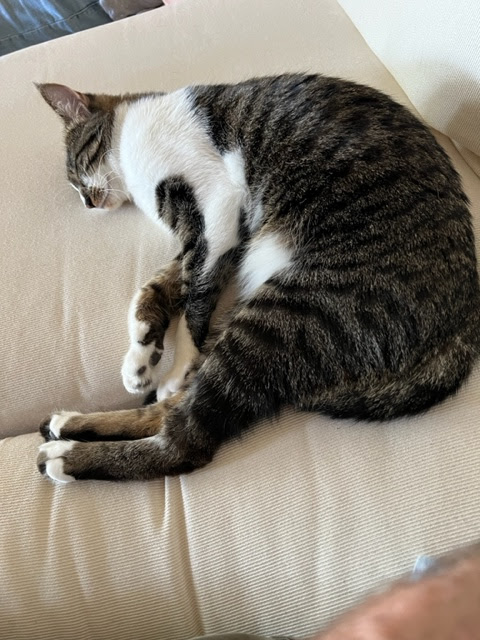
I saw it firsthand after my cat Murphy died earlier this year. She’d been diagnosed with cancer just weeks before. She was a small gray tabby with delicate paws who, even during chemotherapy, climbed her favorite dresser perch – Mount Murphy – with steady determination. The day after she died, a colleague said with a shrug: “It’s just part of life.”

That phrase stayed with me – not because it was wrong, but because of how quickly it dismissed something real. Murphy wasn’t just a cat. She was my eldest daughter – by bond, if not by blood. My shadow.

Why pet grief doesn’t count    

More than two-thirds of U.S. households include pets. Americans tend to treat them like family with birthday cakes, shared beds and names on holiday cards.

But when someone grieves them like family, the cultural script flips. Grief gets minimized. Support gets awkward. And when no one acknowledges your loss, it starts to feel like you weren’t even supposed to love them that much in the first place.

I’ve seen this kind of grief up close – in my research and in my own life. I am a psychologist who studies attachment, loss and the human-animal bond.

And I’ve seen firsthand how often grief following pet loss gets brushed aside – treated as less valid, less serious or less worthy of support than human loss. After a pet dies, people often say the wrong thing – usually trying to help, but often doing the opposite. Many Americans consider pets family members.

When loss is minimized or discounted

Psychologists describe this kind of unacknowledged loss as disenfranchised grief: a form of mourning that isn’t fully recognized by social norms or institutions. It happens after miscarriages, breakups, job loss – and especially after the death of a beloved animal companion.

The pain is real for the person grieving, but what’s missing is the social support to mourn that loss.

Even well-meaning people struggle to respond in ways that feel supportive. And when grief gets dismissed, it doesn’t just hurt – it makes us question whether we’re even allowed to feel it.

Here are three of the most common responses – and what to do instead:

‘Just a pet’

This is one of the most reflexive responses after a loss like this. It sounds harmless. But under the surface is a cultural belief that grieving an animal is excessive – even unprofessional.

That belief shows up in everything from workplace leave policies to everyday conversations. Even from people trying to be kind. But pet grief isn’t about the species, it’s about the bond. And for many, that bond is irreplaceable.

Pets often become attachment figures; they’re woven into our routines, our emotional lives and our identities. Recent research shows that the quality of the human-pet bond matters deeply – not just for well-being, but for how we grieve when that connection ends.

What’s lost isn’t “just an animal.” It’s the steady presence who greeted you every morning. The one who sat beside you through deadlines, small triumphs and quiet nights. A companion who made the world feel a little less lonely.

But when the world treats that love like it doesn’t count, the loss can cut even deeper. It may not come with formal recognition or time off, but it still matters. And love isn’t less real just because it came with fur. If someone you care about loses a pet, acknowledge the bond. Even a simple “I’m so sorry” can offer real comfort.

‘I know how you feel’

“I know how you feel” sounds empathetic, but it quietly shifts the focus from the griever to the speaker. It rushes in with your story before theirs has even had a chance to land.

That instinct comes from a good place. We want to relate, to reassure, to let someone know they’re not alone. But when it comes to grief, that impulse often backfires. Grief doesn’t need to be matched. It needs to be honored and given time, care and space to unfold, whether the loss is of a person or a pet.

Instead of responding with your own story, try simpler, grounding words:

You don’t need to understand someone’s grief to make space for it. What helps isn’t comparison – it’s presence. Let them name the loss. Let them remember. Let them say what hurts. Sometimes, simply staying present – without rushing, problem-solving or shifting the focus away – is the most meaningful thing you can do. Pets frequently make a showing in family photos and holiday cards. 

‘You can always get another one’

“You can always get another one” is the kind of thing people offer reflexively when they don’t know what else to say – a clumsy attempt at reassurance.

Underneath is a desire to soothe, to fix, to make the sadness go away. But that instinct can miss the point: The loss isn’t practical – it’s personal. And grief isn’t a problem to be solved. This type of comment often lands more like customer service than comfort. It treats the relationship as replaceable, as if love were something you can swap out like a broken phone.

But every pet is one of a kind – not just in how they look or sound, but in how they move through your life. The way they wait for you at the door and watch you as you leave. The small rituals that you didn’t know were rituals until they stopped. You build a life around them without realizing it, until they’re no longer in it.

You wouldn’t tell someone to “just have another child” or “just find a new partner.” And yet, people say the equivalent all the time after pet loss. Rushing to replace the relationship instead of honoring what was lost overlooks what made that bond irreplaceable. Love isn’t interchangeable – and neither are the ones we lose.

So, offer care that endures. Grief doesn’t follow a timeline. A check-in weekly or months later, whether it’s a heart emoji, a shared memory or a gentle reminder that they’re not alone, can remind someone that their grief is seen, and their love still matters.

When people say nothing

People often don’t know what to say after a pet dies, so they say nothing. But silence doesn’t just bury grief, it isolates it. It tells the griever that their love was excessive, their sadness inconvenient, their loss unworthy of acknowledgment.

And grief that feels invisible can be the hardest kind to carry. So, if someone you love loses a pet, don’t change the subject. Don’t rush them out of their sadness. Don’t offer solutions.

Instead, here are a few other ways to offer support gently and meaningfully:

  • Say their pet’s name.
  • Ask what they miss most.
  • Tell them you’re sorry.
  • Let them cry.
  • Let them not cry.
  • Let them remember.

Because when someone loses a pet, they’re not “just” mourning an animal. They’re grieving for a relationship, a rhythm and a presence that made the world feel kinder. What they need most is someone willing to treat that loss like it matters.

-The Conversation, Brian N. Chin, Assistant Professor of Psychology, Trinity College


                              Apollo

Zoe and Apollo were my two cats years ago: 

https://teacherpoetmusicianglenbrown.blogspot.com/2023/10/cats.html


Saturday, June 7, 2025

Cats


Over millions of years of evolution, cats have remained remarkably unchanged not out of stagnation, but because they reached a state of near perfection early on. According to evolutionary biologist Anjali Goswami, felines exemplify what it means to be “evolutionarily perfect.” While countless species have morphed, branched, and adapted into new forms to fit shifting environments and ecological niches, cats have stayed true to a singular, razor-sharp blueprint: solitary, stealthy, and lethally efficient hunters.

From the tiniest domestic tabby to the towering Bengal tiger, the feline body plan remains astonishingly consistent. Their skull shapes, musculature, limb proportions, and even behavioral instincts exhibit only minor variations most of them tied to scale rather than function. This is not a sign of biological laziness but a testament to the power of optimization. Cats found a role that worked, and evolution agreed.

Unlike animals like bears, which have diverged into vastly different forms (from bamboo munching pandas to seal hunting polar bears), cats refined and repeated one masterful design. Their bodies are built for quiet stalking, explosive pouncing, and precise killing. Soft paws pad silently. Eyes see in twilight. Claws retract until needed. The design leaves little room for improvement.

This evolutionary stasis where change becomes unnecessary reveals a deeper truth: when nature produces something that works exceptionally well, it tends to leave it alone. In the case of cats, evolution didn’t reward diversification, but perfection through constancy. Across continents and centuries, their form endured, as potent and effective in jungles as in living rooms.

-Taylor Mcmahon, FB


Wednesday, April 2, 2025

Chris Arsenault


Medford, Long Island (WABC) -- The owner of a cat sanctuary and an unknown number of cats were killed in a fire on Monday morning.

The blaze broke out around 7:15 a.m. at the Happy Cat Sanctuary on Dourland Road. The home served as a safe haven for hundreds of cats.

Officials say owner Chris Arsenault, 65, was found on the main floor in the back of his home. Roughly 100 cats have been found so far -- both dead and alive.

Friends say Arsenault went back into the home to rescue the animals after the fire broke out.

"This man lived in an 8x10-foot bedroom with a mini fridge and a microwave, every dime he made, everything he collected went toward the animals, he was selfless, he took nothing for himself, this is just so unfair," said friend Lisa Jaeger.


Wednesday, June 12, 2024

Max the Cat Is a "Doctor of Litter-ature"


For many graduates, their college degrees come at the end of at least four years spent roaming the campus. Max, a 6-year-old tabby, is no different. Except now, he’s a Doctor of Litter-ature.

He’s been visiting Vermont State University’s Castleton campus ever since his owner, Ashley Dow, began letting him out of the house, which is within walking distance of the school.

Maurice Ouimet, the school’s dean of admissions and enrollment services, said the “very affectionate” Max is usually the first to greet him in the morning and will even come inside the admissions office in the wintertime.

“The rest of his daily routine really revolves around where our students are at,” Ouimet said.
“So, he’ll frequently head up the hill and park himself outside one of our main academic buildings so as students come and go from class, he’ll oftentimes just be sitting on the wall.”

Max doesn’t shy away from climbing all over the students, Dow said, and “so he’ll get up and get on their backpacks and they’ll walk around and everybody’s doing selfies.”

“I would say he’s a charismatic cat because he just brings people to him,” Ouimet said, adding Max often reciprocates bystanders’ affections by “standing up and purring.”

Max also greets visitors who come for tours of the school, with Ouimet saying the tabby “feels like he has a job to do in welcoming people to the campus.”

Max earned a degree at a pivotal time in the university’s history. Vermont State University’s 2024 class marks the first combined graduating class after the merger of Castleton University, Northern Vermont University and Vermont Technical College. The three schools combined to form Vermont State University in the summer of 2023.

The university communications office created a countdown to graduation to “build up and celebrate this year’s seniors” who not only went through the Covid-19 pandemic as freshmen but also dealt with the transition that resulted from the merging of the schools, according to Ouimet.

It was the school’s social media manager, Rob Franklin, who had the idea to make Max a part of that historic class – with an honorary doctorate in “Litter-ature.”

According to Ouimet, the university does not actually award doctorates (at least not to people), leaving Max in an exclusive club of one.

“It was just intended to be just kind of lighthearted and kind of a joke but at the same time, realize that this cat did conjure up real feelings and real emotions and was a real support to a lot of people on our campuses during a difficult time,” Ouimet said.

When Dow found out about Franklin’s idea, she laughed. “I’m like, ‘Really? OK,’” she said. “And I had no idea what it was going to open up.” The furry graduate even has his own school email and directory page.

Dow and her daughter, Kaitlyn Tanner, a student at Vermont State, monitor Max’s email and have responded to messages from as far as Germany and England.

Dow says there was recently a feral cat problem in the community, causing Max to be regularly attacked by other cats. So, she put posters around campus asking students to send her a text or bring Max home if they saw him out after dark. Soon, they were arriving on her doorstep with Max in hand.

As far as celebrating his graduation, Dow said Max did not walk at the ceremony on May 18 but his name was called.

With summer coming on, Ouimet doesn’t see Max taking a break from his school visits since the campus is home to summer camps.

“He’ll be out there getting all the attention and I think he’ll just be a little more famous this year,” he said. “People will be like, ‘Hey, that’s Max! He’s the famous cat.’”

-CNN


Considering the amount of music played in my home, my Lucy has a DMus Degree! 


Wednesday, March 13, 2024

Alley Cats


Alley Cat Allies is compelled to address the shockingly biased and dangerously misinformed portrayal of Trap-Neuter-Return (TNR), community cats, and the people who protect them in the article ‘How the ‘No Kill” Movement Betrays Its Name’ published in The New Yorker.

The “article,” which should be labeled an opinion piece, uses debunked and antiquated studies to advocate for lethal control of cats outdoors, all while desperately downplaying the only humane and effective approach—Trap-Neuter-Return (TNR)—and condescending to or downright insulting the people who do the real legwork to benefit cats and communities.

Writer Jonathan Franzen purports various cynical, imagined reasons why our movement calls unowned cats who live outdoors “community cats.” We’re here to clear the air: Community cats, who live and thrive in their natural outdoor homes among us, are called such to acknowledge their thousands of years of history as members of our communities.

Community cats are bonded to their outdoor homes and to their feline families, and they are not generally candidates for adoption. TNR acknowledges their nature, their biology, and their inherent value as beings deserving of respect and protection by allowing these cats to continue their lives in familiar surroundings while ensuring their population stabilizes.

TNR is the ONLY evidence-based, humane, and effective approach to cats outdoors. Spaying or neutering means fewer kittens born outdoors and the reduction of behaviors associated with mating—including yowling, spraying, fighting and roaming. 

Additionally, vaccinations provided during TNR improve the cats’ health and address community health concerns—though it’s critical to note that cats are extremely unlikely to spread rabies,  toxoplasmosis, or any other diseases. The success of community TNR programs is studied and documented.

TNR is also the primary way community cats with other medical issues receive the care they need— despite Franzen hammering in the idea that all cats are suffering outdoors (there’s a sinister motive for this, as we’ll describe later), community cats are generally healthy and in good condition and live as long and fulfilling of lives as indoor cats.

Developing objective, science-first best practices aimed at humane care for animals, building peaceful communities, and protecting all species should be the top priority in our modern world. That is why Trap-Neuter-Return (TNR) has become mainstream practice. 

Beyond saving cats’ lives, TNR is sound public policy that reduces calls to animal control, reduces the number of cats entering shelters, and reduces taxpayer expense, all while meeting the demands of the public for effective, meaningful, AND lifesaving action for cats in their communities.

Franzen writes about TNR as under-resourced in far too many communities. The logical solution would be for local governments to devote more resources to TNR to improve its reach and efficacy rather than continue to waste money on ineffective lethal schemes. 

Franzen’s conclusion, though, is that lack of resources means TNR will never work. He believes cats should be killed—and his portrayal of cats as constantly suffering outdoors is meant to justify lethal schemes.

TNR opponents’ proposed “alternatives” to TNR come down to rounding up and killing cats over and over and over again. However, trapping cats and “euthanizing” them in shelters is not some untested idea; it was the status quo for decades and failed miserably due to the Vacuum Effect—a phenomenon in which other cats move in to take advantage of the resources that sustained the colony that was removed. 

Alley Cat Allies launched TNR into the mainstream against a backdrop of endless, futile, and cruel catch and kill cycles in the United States, and we were successful because communities recognized the need for change. They saw that compassionate and humane approaches worked.

Franzen, like many in the anti-TNR crowd, cites the same debunked junk “science” that keeps coming back to haunt us within so-called “factual” articles. That “science” is an exercise in Olympic gymnast-level contortion to fit the findings of older studies into a pre-determined conclusion that cats are a major threat to birds and other wildlife species.

Cats have an important place in ecosystems, and whenever they are removed in large numbers, the consequences are dire—not just for the cats but for local wildlife. The reality is cats are not a major threat to wildlife species, endangered or otherwise, and the “science” that claims such is heavily flawed and funded by fringe interests and biased parties. 

As we have seen time and time again, catch and kill leads to nothing but an endless cycle of expensive and morally bankrupt slaughter that does not benefit cats, community, or wildlife.

But, on a positive note, the reality is also that we can protect both cats and wildlife. The interests are not mutually exclusive. By advocating for stronger TNR programs backed by local governments AND policies that curb human-led activities that are the true threats to wildlife—like habitat destruction and pollution—we improve the lives of cats, wildlife, and us all.

Like all worthwhile goals, communitywide effort is the key to humane and effective programs and policies. Rather than condescending and stereotyping cat caregivers, as Franzen does repeatedly in his article, Alley Cat Allies supports them with humane education on best practices for TNR and community cat care. 

Rather than give community leaders an excuse to give up on humane programs and utilize taxpayer dollars on an endless cycle of killing cats, we push them to work WITH members of their communities and allot funds to what their people believe in—which overwhelmingly is non-lethal approaches.

It’s time for communities, local governments, and media outlets like The New Yorker to stop wasting words, space, money, and time on calls to backtrack to the dark ages of killing cats and kittens endlessly. TNR is the only way forward.

-Alley Cat Allies: https://www.alleycat.org/

The success of community TNR programs is studied and documented.


Friday, October 13, 2023

Cats


Sometime around the invention of agriculture, the cats came crawling. It was mice and rats, probably, that attracted the wild felines. The rats came because of stores of grain, made possible by human agriculture. And so cats and humans began their millennia-long coexistence.

This relationship has been good for us of course—formerly because cats caught the disease-carrying pests stealing our food and presently because cleaning up their hairballs somehow gives purpose to our modern lives.

But this relationship has been great for cats as species, too. From their native home in the Middle East, the first tamed cats followed humans out on ships and expeditions to take over the world—settling on six continents  with even the occasional foray to Antarctica.


Domestication has been a fantastically successful evolutionary strategy for cats. A comprehensive new study of DNA from ancient cat skeletons and mummies spanning 9,000 years traces the spread of cats from the Middle East to the rest of the world. The whole study, from conception to publication, took about 10 years—not least because of the work it took to find ancient cat remains.

“Cat remains are scarce,” says Eva-Maria Geigl, a paleogeneticist at Institut Jacques Monod and an author on the study. We don’t eat cats for food, so their bones don’t end up in ancient trash piles the way pig or chicken bones do. Geigl and her colleagues, especially Wim Van Neer, wrote to museums and collections asking to sample cat remains found in archeological digs.

The team ultimately got bone, teeth, or hair from 352 ancient cats—including Egyptian cat mummies at the British Museum. Not all of the remains yielded DNA. The Middle East environment is hot. In Egyptian tombs, where the cat mummies came from, it was also humid.

“This is really a disaster for DNA,” says Geigl. The very act of extracting DNA can damage it, too. So to protect the DNA from heat released when bones and teeth are ground, the grinding process happens in a liquid nitrogen bath. Ultimately, the team was able to get DNA from 209 of the cats. This large number of samples painted a fairly detailed picture of how cats followed humans on trade routes.


Modern domestic cats appear to have all originated in one of two places.  The first was Anatolia, which roughly corresponds to modern-day Turkey. These cats spread to Europe as early as 4,400 B.C.E. A second domesticated lineage appears to have begun in Egypt and then later spread through the Mediterranean. And wherever the cats followed humans, they also interbred with the native wildcats already there.

This DNA exchange went both directions along the trade routes, too. That led to what, at first, seemed like baffling results in the ancient DNA. For example, a 2,000-year-old cat in Egypt had DNA sequences typical of wildcats in India.  Claudio Ottoni, another member of the research team now at the University of Oslo, remembers thinking it was a mistake when he first got the sequences back on his laptop.

In fact, that cat was found in an ancient Roman port city called Berenike, which was directly connected to trade routes in the Indian Ocean. Humans brought cats onto ships to catch mice and, in the process, spread cats all around the world. Compared to many other animals, cats have also changed very little in the domestication process.

Behaviorally, they’ve become more tolerant of humans. Physically, though, they’re still about the same size and shape. They still like to pounce on small prey. “Cats have done since before they were domesticated what we needed them to do,” says Leslie Lyons, a feline geneticist at the University of Missouri.


In other words, unlike dogs that herd sheep or hunt badgers, cats didn’t need humans to breed them to become good mouse hunters. But wildcats and pet cats do look differently in a small but obvious way to humans: Domestic cats come in a great variety of colors and coat patterns. From the ancient DNA, Geigl and her colleagues determined that the tabby pattern first emerged in the Middle Ages based on a single letter mutation in the Taqpep gene.

This was the only coat gene Geigl and her colleagues investigated. For the most part, their analysis focused on DNA in a part of the cell called mitochondria, which is more abundant than DNA in chromosomes but accounts for only a tiny fraction of genes.

This is a good start, says Greger Larson, a paleogenomicist at Oxford, and it sets the stage for using ancient chromosomal DNA to further refine the story of ancient cats. Larson has done similar work with ancient dog DNA. “It’s great that cats are the getting same long deserved treatment,” he says of the new paper. “It’s kind of strange it’s taken this long given the general interest in cats.”

The dog days of ancient cat DNA are over.

-Sarah Zhang is a staff writer at The Atlantic.


Friday, January 27, 2017

My Beloved Cats


                  Apollo (April 2004 - September 24, 2012)    
  
                        Zoe (April 2004 - January 27, 2017)


                                                         Apollo 2011


                                                  Zoe 2016